
Disinformation Report: October 12-18
How Anti-Trans Attacks Are Landing Across TFA’s Priority States — and How Campaigns Should Answer
13 PRIORITY STATES | 772 STATE-TAGGED POSTS | 41.1M ENGAGEMENTS |
The largest item in the week’s transgender material, of any kind, was a single post attacking the Democratic Senate nominee in Texas on the day before early voting opened there: 30.32 million engagements, 99.99% of them video views. Texas took 93% of the thirteen-state map. The nominee had told a televised town hall on Oct 14 that he supports a national ban on gender-affirming surgery for minors, and the attack did not narrow afterward. The largest item in which a Democratic candidate refused the premise outright came from Montana’s First District, where a nominee answered a debate question on transgender rights by saying government “has no business” in those decisions, and a political-clip account’s upload of the exchange carried 830,051. New Republican-side transgender creative started inside this window in eleven watched races, including the first prisons-framed paid creative this series has recorded in a Senate race, and no paid transgender copy appeared on Meta in Texas’s Senate race. Three of the thirteen state columns rest largely on material with no new event behind it. This ninth weekly edition covers who drove each state’s attacks, what is now being paid for and by whom, and where the openings are.
Data: Trans Rhetoric Social Media Dashboard
79K+ channels · 18 platforms · 1M+ posts · Weekly electoral briefing
Topline Finding
One post was the largest item in the week’s transgender material, of any kind, and it was aimed at a Senate campaign. On Oct 18, the day before early voting opened in Texas, a conservative account with a large following on X posted a compilation of four statements attributed to State Rep. James Talarico, the Democratic nominee for Texas’s open U.S. Senate seat — “God is non-binary,” “In fact, there are six” biological sexes, “neighbors with a uterus,” and that parents who deny a child’s gender identity are “abusive for sure” — closing “Early voting starts tomorrow, Texas.” It reached 30,322,694 engagements. Two readings of that figure fit the record and this briefing does not choose between them. The figure is 99.99% video views (30,319,205 views against 2,518 likes), a ratio of about 12,000 views per like, more than four times the next-highest ratio in the week’s large posts, which is consistent with paid amplification on the platform; it is also consistent with an ordinary video that was watched and not reacted to. Platform amplification of an organic post appears in no advertising library. Campaigns should assume that the largest single item in a closing week can arrive from an account that no library search will surface.
Texas carried 38.27M, 93% of the thirteen-state map and the largest state figure this series has recorded. The post above is 79% of that column; without it Texas reads 7.95M, which would still rank first. Posts naming Talarico in any form carried 38.51M across 1,362 posts; posts naming Attorney General Ken Paxton, the Republican nominee, carried 1.86M across 402. The week’s Texas event was a televised town hall on Oct 14 in Fort Worth, held by CNN and the interview producer Jubilee, at which Talarico said his past “God is non-binary” remark was “provocative” and said of surgery for minors, “if there’s something that’s going to endanger a child or a minor… then I’m always going to try to err on the side of protecting those kids.” CNN reported that he supports a national ban on gender-affirming surgery for people under 18. The thirteen states together carried 41.12M against 13.53M the week before.
The largest item this week in which a Democratic candidate refused the premise outright came from Montana. At the Oct 13 debate in Missoula for Montana’s First District, hosted by Montana Free Press and NonStop Local, Sam Forstag, the Democratic nominee, was asked about transgender rights after Republican nominee Aaron Flint raised his 2021 lobbying for the American Civil Liberties Union against House Bill 112, the 2021 law requiring athletes in school and college sports to compete according to sex assigned at birth, which Montana’s courts later struck down as applied to colleges. Forstag answered that his mother “taught me that government has no business sticking its nose into our personal lives, whether that’s a gun safe, whether that’s a doctor’s office,” and “let’s let people live their lives with dignity and make their own private personal decisions and let’s keep politics the heck out of it.” A political-clip account carried the exchange to 830,051, and the chain ran to 50 posts and 870,660 in all. Public polling has shown the race a statistical tie. The observation is that the answer traveled; whether it helped or hurt the candidate is not established by engagement data. CNN’s own post on the Texas nominee’s town-hall answer carried more, at 1,280,578, but that answer moved toward the premise rather than declining it.
Three of the thirteen state columns rest largely on material with no new event behind it. Minnesota’s column is mostly relays of a mid-August interview with Lt. Gov. Peggy Flanagan, the Democratic Senate nominee; Michigan’s is mostly a federal Title IX suit filed Oct 9 over a volleyball match played in September 2025; and Maine’s is mostly a conspiracy post tied to no event. In Texas, apart from the compilation, the older clip that recirculated hardest against the Senate nominee after the town hall — 129 posts and 323,529 engagements, 82% of it on Oct 17 and Oct 18 — was a line from a 2022 sermon. Campaigns should date every item before repeating or rebutting it.
The week’s largest story outside Texas was a school-sports protest in a state that is not on this map, where the subject is on the ballot. On Oct 13 about half of the girls’ cross-country team at Camas High School in Camas, Washington walked off the course at a meet rather than race against a teammate whom local news reporting describes as transgender; the district said the athlete had not violated eligibility rules and the state association said it had received no eligibility challenge. The story ran on 224 posts for 11.18M, with 8.48M of it on Oct 14 alone and its two largest uploads, at 3.64M and 2.60M, from one national outlet. Washington votes on Nov 3 on Initiative 638, which would bar transgender girls from girls’ school sports and require medical verification of a student’s sex. A campaign in a state with a measure on this subject should expect a local incident to become national within a day.
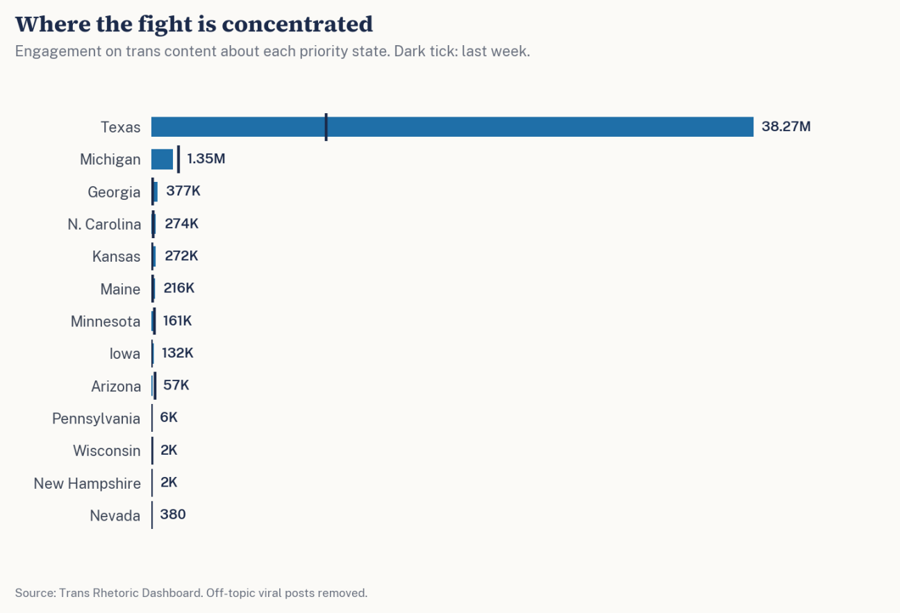
Reach by priority state, Oct 12 – 18, with the prior week marked by a dark tick. Eight states rose — Texas, Georgia, North Carolina, Kansas, Maine, Iowa, Pennsylvania and Nevada — and five fell: Michigan, Minnesota, Arizona, Wisconsin and New Hampshire.

Texas alone is 93% of the week’s priority-state reach, against 82% for Texas the week before, and nine of the thirteen states cleared 30K against seven last week. The map measures attention; it does not rank the severity of attacks. Nevada and New Hampshire are the quietest columns.
Narratives by Race
Every watched race appears every week; ad figures are the libraries’ lifetime ranges per creative, and neither library covers television. Rows covering a statewide race or measure in a priority state, and Ohio’s, show the state total; district-only rows and the other out-of-map rows (Mississippi, Florida and Nebraska) count posts naming the candidates.
RACE | STATUS | THE STORY THIS WEEK | REACH | WHERE IT’S RUNNING |
Texas Senate + Governor | ■ PAID | A single post compiling four statements it attributed to the Democratic Senate nominee reached 30.32M the day before early voting; at a televised town hall on Oct 14 he said he supports a national ban on gender-affirming surgery for minors; a 2022 sermon line recirculated on 129 posts for 324K; posts naming the governor’s-race candidates carried 259K | 38.27 M | No paid transgender copy from either Senate nominee on Meta this week; the Meta wave from America PAC, the super PAC funded by Elon Musk, ended in Texas on Oct 5 and nothing replaced it there. An exact search for “God is nonbinary” returns two newspaper promotions (Oct 17–18, under $100 each), two pollster cards and a Texas congressman’s fundraising card, the last three with their transgender content in the video, none of them Senate creative. Two news-styled “Longhorn Ledger” cards ended Oct 12 under $100 and are not counted as paid. In the governor’s race, Texans for Greg Abbott’s card against Gina Hinojosa, the Democratic nominee — “Gina supports tax-payer funded sex changes for kids, prosecuting parents for misgendering their children, and boys in girls’ sports” — ended Oct 17 at $10K–$15K and 800K–900K impressions. Statewide, the Republican Attorneys General Association’s card for its attorney-general candidate is active at $70K–$80K, which does not change this row. Google records $11.57M added in-state, the largest of the eighteen states in Google’s bundle, $1.80M of it from America PAC and the two Senate campaigns; none of their Google creatives was played this week, so their content is not reviewed |
Georgia Senate + statewide | ■ ORGANIC | Three relays of the President’s Oct 16 rally in Dalton, where he said “we have five states where your child goes off to school as Tim and comes back as Tammy three or four days later,” a claim for which there is no evidence, are 74% of the state; a post by Kelly Loeffler, a former Georgia senator who now heads the Small Business Administration, listing the incumbent’s votes including “NO to banning boys in girls’ sports,” carried 86K | 377K | No candidate trans copy on Meta for Sen. Jon Ossoff, the Democratic incumbent, or Rep. Mike Collins, the Republican nominee, a seventh week. Moms for Liberty Georgia, a conservative parents’ group, has had a card active since Oct 8, now at $2K–$2.5K and 150K–175K impressions; it is a state-level issue card naming no candidate or race in this row, so the row stays Organic. Google records $4.17M added in-state; one of Collins’s two largest creatives, played this week, is an immigration spot with no transgender text |
Ohio Senate · 9th District | ■ PAID | A WEWS News 5 Cleveland finding, reprinted by the Ohio Capital Journal, that an advertisement’s testimonial witness is from Texas, not Ohio, and did not have surgery as a minor reached the state’s column through posts of the historian Heather Cox Richardson’s daily newsletter (112K and 11K), in which it is one item among several; the Democratic Senate nominee answered the advertisement with his own card | 231K | The Senate Leadership Fund, the Senate Republican leadership’s super PAC, kept the detransition testimonial running with new Oct 13 cards: $10K–$15K and above a million impressions on each of two, $6K–$7K on a third, all ended Oct 17–18; its Oct 8 set closed at up to $50K–$60K. Its news-styled “Ohio Pulse” page, whose disclaimer reads “Paid for by SLF PAC,” added two cards Oct 13–16, the larger at $4K–$4.5K and 500K–600K. America PAC’s card ran Oct 11–19 at $8K–$9K and 250K–300K — about $900–$1,000 a day over nine days. NEW, Democratic side: former Sen. Sherrod Brown’s own page opened four cards from Oct 16, the largest at $3K–$3.5K and 250K–300K — “The woman attacking Sherrod Brown isn’t from Ohio and didn’t have any surgery as a minor.” In the 9th, the “men play girls’ sports” card from the Congressional Leadership Fund, the House Republican leadership’s super PAC, ended Oct 15 at $8K–$9K |
Michigan Senate | ■ PAID | A federal Title IX suit filed Oct 9 by a 16-year-old volleyball player and her father over a September 2025 match carried 473K on Libs of TikTok and 263K on a former college athlete’s account, 54% of the state; 2021 and 2022 podcast remarks by Abdul El-Sayed, the Democratic Senate nominee, which a conservative outlet presented as support for covering gender-transition care for undocumented immigrants (in one he was describing a conservative objection), carried 117K | 1.35M | America PAC’s two sports-framed ballot-return cards in the Senate race ran into this window and ended Oct 12, at $4K–$4.5K and at $3K–$3.5K; nothing from either campaign replaced them, and no new trans creative started in the race on Meta. Google records $6.49M added in-state; none of the race’s Google creatives was reviewed |
Kansas Senate + Governor | ■ PAID | Two clips of Sen. Roger Marshall’s Oct 12 Newsmax interview, in which he called Adam Hamilton, the Democratic Senate nominee, “a transgender apologist,” carried 212K between them, 78% of the state; two copies of a Trump post naming Hamilton on “Men in Women’s Sports” carried 37K | 272K | Senate Leadership Fund’s Oct 9 cards ended Oct 14–15 at up to $15K–$20K and 800K–900K impressions, and three new cards from Oct 14 are active — $5K–$6K and 450K–500K on the largest, $2K–$2.5K on each of two — all carrying “Hamilton even supports biological men in girls’ sports.” Sen. Marshall’s own page card ended Oct 14 at $4.5K–$5K. No trans copy in the governor’s race. Google records $2.20M added in-state, and WinSenate, a Democratic Senate group, is new to the state at $150,900, subject not shown |
Maine (statewide) | ■ PAID | One conspiracy post and one relay of it, falsely asserting that a series of public figures, among them the governor, are secretly men, are 90% of the state; the largest in-state item is a legislator’s post about the Washington cross-country protest (10K) | 216K | NEW: the National Republican Senatorial Committee opened a prisons line against Troy Jackson, the Democratic Senate nominee, on Oct 17 — three active cards, the largest $1K–$1.5K and 40K–45K: “Troy Jackson backed legislation allowing biological male prisoners into female prisons, leading to horrific claims of assault from female inmates…” Lead Maine Committee, a super PAC, closed its Oct 2 set Oct 14–18 (lead card $1K–$1.5K, 200K–250K) and opened a card Oct 13 ($600–$699, 100K–125K) plus at least four under $100 on Oct 17, the Oct 13 and Oct 17 cards carrying “Boys in Girls’ Sports.” Three video-only matches — two from a pro-Collins group, one from Sen. Susan Collins’s own page — carry no written transgender line and their video context was not seen; a fourth, from a state House candidate’s page, does not change this row |
Minnesota (statewide) | ■ ORGANIC | No new event in either race: the state’s 161K is mostly four relays of a mid-August CNN interview with the Democratic Senate nominee on an age limit for gender-affirming care (56K on the largest), plus one post (55K) on an NCAA softball player’s account of a threat over her women’s-sports advocacy, which recirculates her team’s 2025 state-tournament loss | 161K | No trans copy and no video-only match in either race in 20 searches of both nominees’ names, the state and sports terms. The two Sept 17 videos from Michele Tafoya, the Republican Senate nominee, did not appear in this window’s results. Google records $2.05M added in-state; the one creative read on her main advertiser page is a fundraising text advertisement, and a second creative there and a second advertiser entry were not opened |
Iowa Senate + Governor | ■ PAID | The Republican nominee for governor’s campaign and an allied activist carried the claim that Rob Sand, the Democratic nominee, attends a church that hosts drag performances and invited a transgender pastor (67K across three posts, 51% of the state) | 132K | A Senate Leadership Fund–paid page against Josh Turek, the Democratic Senate nominee, closed its Oct 8 card Oct 15 at $1.5K–$2K and ran a new one Oct 15–17 ($100–$199, 10K–15K); neither has written copy and both were returned by a keyword search on words spoken in the video. No trans copy on Meta from any statewide candidate on either side. Google records $4.77M added in-state, including $205,500 and 13 new creatives from the campaign of Zach Lahn, the Republican nominee for governor, among them the largest new Iowa creative of the window at $60K–$70K; their content was not reviewed |
Iowa 2nd and 3rd Districts | ■ PAID | Posts naming the 2nd District candidates carried 10K and the 3rd District’s 7K. In the 2nd, most of it was the campaign posts of Joe Mitchell, the Republican nominee (“sex changes for children”), and the national House committee’s clip of him (“Allowed kids to have sex changes”), and Mitchell’s war-room account called the Democratic nominee’s church one that “helps children as young as 5 become trans” (174) | 17K | NEW in the 3rd: the Congressional Leadership Fund’s “Just Plain Dangerous,” two cards from Oct 16, $1.5K–$2K each — “Sarah Trone Garriott voted to let grown men in girls’ locker rooms… boys in girls’ sports… supports gender transition surgeries for minors.” Rep. Zach Nunn’s campaign added two Oct 13 cards ($300–$399 each); his war-room pair ended Oct 12–13 at $1.5K–$2K. NEW in the 2nd: Mitchell’s own campaign from Oct 16 ($500–$599, 50K–60K) — “Lindsay James wants higher taxes, benefits for illegal immigrants, and boys in girls sports” — the first attack creative on this issue this series has found on Meta in the 2nd, where the Sept 14 edition recorded an outside group’s spot on “boys in girls’ sports” that the Democratic nominee answered with a television advertisement. The counter-frame from Common Ground Coalition PAC, a Democratic-side super PAC registered in September, is also active against him in the 2nd. No response creative on the issue from either Democratic nominee |
Pennsylvania 7th and 8th Districts | ■ PAID | No transgender-issue narrative from any of the four candidates, a sixth week, and posts naming them carried no engagement; only the Democratic-side counter-frame in the 8th is running. The state’s 5,585 is its third-lowest in this series | 0 | In the 8th only: the Democratic-side Common Ground Coalition’s counter-frame against the Republican nominee continues, top card $400–$499 and 100K–125K, which is what this row rests on. No trans creative in the 7th in 10 searches, including both short forms of the Democratic nominee’s name; the Newsmax correspondent who shares that name produced none of the sports clips returned. Statewide, America First Works, a conservative advocacy group, is active from Oct 6 ($900–$999), naming no candidate |
Wisconsin Governor + 3rd District | ■ PAID | No transgender-issue narrative from any candidate; the state’s 2,262 engagements are its second-lowest in this series and describe nine posts | 2.3K | Independent Women’s Voice, a conservative women’s advocacy group, is active since Oct 1 and now at $8K–$9K and 500K–600K impressions against David Crowley, the Democratic nominee for governor: “Why did David Crowley sponsor a bill to put tampons in men’s restrooms? Why won’t he pledge to sign Wisconsin’s bill to protect women’s sports?” Moms for Liberty Wisconsin, the state chapter of a conservative parents’ group, ended its card Oct 15 at $4.5K–$5K. Nothing in the 3rd. Google records $2.99M added in-state |
New Hampshire (statewide) | ■ PAID | No transgender-issue narrative from either Senate candidate, and the state’s 1,829 engagements describe two posts, neither of them about the Senate race | 1.8K | America PAC’s card against Rep. Chris Pappas, the Democratic Senate nominee, ran into this window and ended Oct 12 at $600–$699 and 6K–7K — “They don’t want you to return your ballot. Why? Because you know boys don’t belong in girls’ sports. Chris Pappas doesn’t.” No new trans creative started in either race across searches of both nominees’ names, the state and sports terms; the two state-level hits are down-ballot and do not change this row |
North Carolina 1st District | ■ PAID | Posts naming the Democratic incumbent carried 32 engagements; the paid attack is the whole of the district’s activity | 32 | NEW: three cards from Oct 13 against Rep. Don Davis, on pages titled “Democrat Don Davis” ($200–$299, 20K–25K; and $100–$199) and “Do Nothing Don Davis” ($100–$199) — on what the cards describe as military funding of transgender procedures, pronoun notification and “sex change operations”; their sponsors are not identified in the library’s search data and should be read from the disclaimers before being cited. Restoration of America PAC, a conservative super PAC, ran a card Oct 12–19 at $10K–$15K and 300K–350K: “Don Davis won’t keep men out of women’s sports.” The Congressional Leadership Fund’s Oct 8 card ended Oct 18 at $7K–$8K |
North Carolina Senate | ■ ORGANIC | The Republican Senate nominee’s own posts are 54% of the state (148K across three), including “Roy Cooper is with they/them” and “a radical transgender agenda”; the removal of Pastor John K. Amanchukwu Sr. by police from an Oct 12 Iredell-Statesville school-board meeting, where he read aloud from a novel in the school library, carried 68K, with the transgender element in the circulating post’s framing of other books rather than in the event | 274K | No trans copy for either Senate candidate on Meta. Four news-styled “Pine & Cardinal” cards from Oct 12 run at under $100 each and are not counted as paid; the two whose copy was read recount the Democratic nominee’s 2023 vetoes. Google records $2.34M added in-state and no creative at all in the window from either of the Republican nominee’s two advertiser pages |
Arizona 1st District + ballot | ■ PAID | A presidential campaign post backing Andy Biggs, the Republican nominee for governor, on ending “the transgender insanity,” and Biggs’s own post attacking Gov. Katie Hobbs over “sex change operations,” carried 23K between them; a post on the President’s Oct 14 rally in Bullhead City carried 7K and a local television report on Proposition 318 carried 6K; posts naming the 1st District candidates carried none | 57K | On Google, two creatives from the joint committee of Jay Feely, the Republican nominee, and the National Republican Congressional Committee ran Sept 29 – Oct 13, inside this window on Oct 12–13, at $25K–$30K and $9K–$10K; played this week, both show the on-screen card “AMISH SHAH / SEX CHANGES FOR CHILDREN” (audio not reviewed). The committee’s three new Oct 14–18 creatives show tax cards, with no transgender text in the frames captured (one was read only to about 0:17, and a survey pop-up covered part of the frame on two). No Feely or committee transgender creative on Meta; the Democratic-side Common Ground Coalition’s counter-frame is active from Oct 9 at $100–$199. Prop 318: searches for “Proposition 318,” “Prop 318” and “Prop. 318” again return no transgender copy on Meta, and the news-styled “Grand Canyon Gazette” page still carries no attack creative |
Arizona 6th District | ■ PAID | No transgender-issue narrative circulated; posts naming either candidate carried 8 engagements | 8 | The Congressional Leadership Fund opened two new cards against JoAnna Mendoza, the Democratic nominee, on Oct 14 and Oct 16 — $3.5K–$4K and 90K–100K on the first, $700–$799 on the second — adding a new line: “In a hidden video, Mendoza supported decriminalizing transgender prostitution.” Its Oct 8 card ended Oct 16 at $4K–$4.5K. America PAC’s card ran Oct 11–18 at $1.5K–$2K. The Democratic-side counter-frame continues. No ad text read this week references the Democratic nominee’s child |
Michigan 7th and 10th Districts | ■ QUIET | No transgender-issue narrative from any of the four candidates, a fifth week; posts naming them carried no engagement | 0 | No trans creative in either race in 20 searches. The one video-only match tied to either race is a pro-Lawrence group’s card with no written transgender line. Google: in the 10th, the Republican nominee’s largest creative, played this week, is a crime spot with no transgender text; in the 7th, the two creatives played, which are not the district’s largest, are an immigration spot and a testimonial with no transgender text |
Mississippi Senate | ■ PAID | A conservative outlet published undercover video on Oct 16 in which Scott Colom, the Democratic nominee, says “I’m not for gender-affirming surgery for children… a ban is not a criminal thing”; posts naming either candidate carried 16K, 85% of it the outlet’s two posts of that video | 16K | The Republican incumbent’s Oct 9 card is active and now at $4K–$4.5K and 150K–175K; its written copy is only “Vote Cindy Hyde-Smith on November 3,” and it is returned by searches for “transgender” and the exact phrase “transgender defender” on words spoken in its video. A site imitating the Democratic nominee’s campaign page, whose footer reads “Paid for by Cindy Hyde-Smith for US Senate,” is still up, and its homepage is the same length as at the Oct 5 and Oct 12 readings, with its title, footer and image descriptions unchanged |
New Mexico 2nd District | ■ PAID | No transgender-issue narrative circulated; the one post naming the incumbent carried 8 engagements | 8 | The Congressional Leadership Fund opened a new card against Rep. Gabe Vasquez on Oct 13 ($900–$999, 40K–45K): “Are you a biological male wanting to join the girls’ sports team? Better call Gabe Vasquez!” Its Oct 10 card ended Oct 15 at $300–$399. The Democratic-side counter-frame is active from Oct 9. Spanish-language searches for the television spot recorded earlier in the cycle return no political advertisement on the first page of results. Google records $572,500 added in-state, the smallest of the eighteen states in Google’s bundle |
Missouri 2nd District | ■ QUIET | No transgender-issue narrative from either candidate; posts naming them carried 1,905 engagements | 1.9K | No trans copy on Meta in either candidate’s searches. The Republican incumbent’s new Oct 14 Google creative, played this week, shows “ANN WAGNER / PROTECTS OUR GIRLS” in a trafficking-survivors context and carries no transgender line. Statewide, both sides of Amendment 3 — which would bar gender-transition procedures for minors alongside its abortion provisions — are advertising, which does not change this district’s row |
Florida Governor | ■ PAID | Posts naming either nominee carried 160K across 16 posts, led by a post on the Democratic nominee’s firearms position that lists “transgender for kids” among his plans (44K) and a page’s post reading “Jolly would let men into women’s sports. Byron Donalds will protect girls’ sports in Florida.” (32K) | 160K | NEW: the Republican Party of Florida ran a card Oct 13–15 ($400–$499, 100K–125K): “David Jolly would reverse the DeSantis legacy in Florida. Jolly will push through higher taxes, tougher gun laws, and a radical trans agenda.” The previous edition recorded this race as Organic, and this card began inside this window. No trans copy in the Republican nominee’s own Meta searches. Google records $5.12M added in-state; his two largest creatives, at $450K–$500K and $600K–$700K and above ten million impressions each, were played this week and show tax and affordability cards, with no transgender text in the frames captured (the first was read to about 0:22) |
Nebraska Senate | ■ PAID | No transgender-issue narrative circulated; posts naming either candidate carried 4,841 engagements | 4.8K | The page titled “Democrat Dan Osborn” changed sponsors inside this window: its cards through Oct 15 carry the disclaimer of Cornhusker Majority, a super PAC backing the Republican incumbent, and the cards it opened from Oct 15 read “Paid for by SLF PAC,” the disclaimer on the Senate Leadership Fund’s Ohio page. Cornhusker Majority’s Oct 6 “Check The Label” card, whose carousel includes a card headed “Men in Women’s Bathrooms,” closed Oct 15 at $25K–$30K and above a million impressions; the same carousel reopened under the SLF PAC disclaimer from Oct 15 ($2.5K–$3K and 40K–45K on one that ended Oct 19, a second still active), and further SLF PAC cards from Oct 15 were returned as matches on words spoken in their videos, the largest at $7K–$8K, while their written copy is about immigration and the “independent” label. Cornhusker Majority’s own page ran early-vote cards Oct 7–15 ($1.5K–$2K) carrying “let men compete in women’s sports.” The challenger the page names is an independent, not a Democrat |
New York 17th District | ■ QUIET | No transgender-issue narrative from either candidate; posts naming them carried 221 engagements across four posts | 221 | No trans creative in the district in 15 searches of the candidates’ names and the transgender, sports and girls combinations. An exact search for “chemical castration,” the phrase in the spot recorded earlier in the cycle, returns no political advertisement on the first page of about fifty-six results. Google: the incumbent’s largest creative, played this week, is a sanctuary-law spot with no transgender text |
Nevada (statewide) | ■ PAID | No transgender-issue narrative circulated; the state’s 380 engagements describe two posts | 380 | In the 2nd District, open this year: House Freedom Action, a Freedom Caucus–aligned super PAC, through its Freedom Caucus Fund page, keeps both cards active since Sept 30 against Teresa Benitez-Thompson, the Democratic nominee — now $1.5K–$2K and 100K–125K on “a Socialist Democrat who supports men in women’s sports” and $700–$799 on “RADICAL TRANS AGENDA.” No trans copy in the governor’s race; the two apparent hits on the Democratic nominee’s surname are an Indiana race. Google records $1.50M added in-state |
Status. Paid: transgender-issue advertising found in the Meta or Google library this week. TV only: a transgender-issue television spot confirmed by press reports or AdImpact, an ad-tracking firm, but not in the online libraries. Unconfirmed: paid activity reported but not verified in the libraries. Organic: the narrative circulated with no paid transgender-issue creative found. Quiet: no transgender-issue narrative in the race this week. A creative found by a keyword match on words spoken in its video counts as found when its page or the matched phrase marks it as an attack on a candidate in the row; other such matches are noted in the row but not counted. News-styled cards under $100 are not counted as paid.
Eighteen rows read “Paid,” the same count as last week, with one race moving in each direction. Florida’s governor’s race entered the paid column on a state party card that began Oct 13; Minnesota left it, because the Republican Senate nominee’s two September videos no longer appear in the library’s window-filtered results and nothing replaced them. Four races read Paid this week only on creative that ran into the window and stopped inside it — the Michigan and New Hampshire Senate races, Ohio’s Ninth District and the Texas governor’s race — so a campaign checking those races on Oct 19 for active advertisements only would have found none in any of them. Across the House races in the table, Republican-side paid transgender-issue creative ran in eight (Arizona’s First and Sixth, Iowa’s Second and Third, New Mexico’s Second, North Carolina’s First, Ohio’s Ninth and Nevada’s Second, the last inside the Nevada row) and the Democratic-side counter-frame in five (Arizona’s First and Sixth, Iowa’s Second, New Mexico’s Second and Pennsylvania’s Eighth).
Four further House races enter this briefing’s coverage this week, and in all four the Meta library shows no transgender-issue advertising on either side; Google’s records for these races were not reviewed. In Montana’s First, Iowa’s First, South Carolina’s First and Nebraska’s Second, searches of both candidates’ full names, each surname paired with transgender, sports and girls terms, each state’s transgender and girls-sports searches and the exact phrases quoted in press reports returned no transgender-issue advertising on Meta in the window. Three carry organic activity: Montana’s First is the Forstag debate exchange above (870,660 across 50 posts); Nebraska’s Second carries the national House committee’s posts attacking Denise Powell, the Democratic nominee, on surgery for minors, and the chain around them (7,029 across nine posts); Iowa’s First carries 3,384 across five. South Carolina’s First carries none. Beyond what Meta shows, Iowa’s First has paid activity on both sides by press account: Erin in the Morning, a news site covering transgender issues, reported on Oct 16 that the Democratic nominee, Christina Bohannan, has an ad running across the district — “As the only one in this race who ran track in high school, it matters to me that girls’ sports are fair” — answering what it described as anti-transgender mailers from Rep. Mariannette Miller-Meeks, the Republican incumbent. Google records 27 new creatives from Bohannan’s campaign in the window, whose content was not reviewed.
Key Findings
New Republican-side transgender creative started inside this window in eleven watched races, and in two of them it is the first creative from that side this series has found on Meta. Maine’s, Nebraska’s, Kansas’s, Ohio’s and Iowa’s Senate races, Iowa’s Second and Third Districts, Arizona’s Sixth, New Mexico’s Second, North Carolina’s First and Florida’s governor’s race all opened cards on Oct 12 or later; this series’ earlier Meta reads found no Republican-side creative on this subject in Florida’s governor’s race or Iowa’s Second, though the Sept 14 edition recorded an outside group’s spot in Iowa’s Second.
The Senate Republicans’ own committee opened a prisons line rather than a sports line. The National Republican Senatorial Committee‘s three Maine cards from Oct 17 attack the Democratic nominee’s record on prisons, the largest saying he “backed legislation allowing biological male prisoners into female prisons” — the first prisons-framed paid creative this series has recorded in a Senate race, and the only prisons line in the Maine row.
Texas produced 93% of the map and its Senate race had no paid transgender copy on Meta. Searches of both nominees’ full names and surnames, the state’s transgender and girls-sports terms and three exact phrases from the attack returned no Senate creative on Meta, where America PAC’s Texas wave ended Oct 5; on Google, America PAC and the two Senate campaigns added $1.80M in the state this week, and those creatives were not reviewed.
A Democratic Senate nominee answered a transgender advertisement with his own paid card. Former Sen. Sherrod Brown, the Democratic nominee in Ohio, opened four cards on Oct 16, the largest, at $3,000–$3,500, reading “The woman attacking Sherrod Brown isn’t from Ohio and didn’t have any surgery as a minor” — answering the advertisement’s factual claim rather than the issue.
A former Republican Speaker of the Texas House said publicly that the advertising is not working. Dade Phelan, who remains a member of the Texas House and is not seeking re-election, told Texas Monthly in an interview published Oct 14, “We’re still running transgender ads. It’s just not resonating,” and said of “the 8 to 10% of voters in the middle who are going to decide this election”: “when they hear stuff about boys in girls’ sports, they don’t even know what you’re talking about.”
A mass text campaign impersonated a Texas transgender advocacy group a week before early voting, and a legislator asked the attorney general to investigate the group. Texas Republicans received texts on Oct 12 and Oct 13 offering guides on “bathrooms and beyond for trans kids at school” and linking to the Transgender Education Network of Texas, which said it did not send them and sent cease-and-desist notices to two messaging companies.
A post asking whether the shooter in an Oregon elementary-school shooting was transgender carried 711,624 engagements and has since been deleted. Nothing in any published account of the Oct 15 shooting at Silver Rail Elementary School in Bend, Oregon says anything about the gender identity of the 16-year-old named by police, and the post reverses his name.
A second Democratic Senate nominee was recorded moving toward the premise, this time on undercover video. A conservative outlet published video on Oct 16 in which Scott Colom, the Lowndes County district attorney and Democratic nominee in Mississippi, says “I’m not for gender-affirming surgery for children… a ban is not a criminal thing”; the outlet’s two posts of the clip are 85% of every post naming either Mississippi nominee this week.
The Battleground at a Glance
A post counts toward a state when the dashboard’s geographic tagging links it to that state, by place or by the state’s races. Many posts that name a state’s candidates, and many from accounts based in a state, carry no state tag, so these figures are floors and measure attention on a state.
STATE | PRIMARY | POSTS | REACH | VS LAST | ANTI / PRO | TOP MESSENGER |
Texas | 3/3/26 | 528 | 38.3M | ▲ 245% | 34.8M / 1.8M | KanekoaTheGreat |
Michigan | 8/4/26 | 83 | 1.4M | ▼ 21% | 1.1M / 15K | Libs of TikTok |
Georgia | 5/19/26 | 14 | 377K | ▲ 481% | 86K / 283K | Aaron Rupar |
North Carolina | 3/3/26 | 21 | 274K | ▲ 136% | 245K / 5K | Michael Whatley |
Kansas | 8/4/26 | 21 | 272K | ▲ 961% | 37K / 10K | Aaron Rupar |
Maine | 6/9/26 | 22 | 216K | ▲ 181% | 195K / 4K | Q The Storm Rider |
Minnesota | 8/11/26 | 28 | 161K | ▼ 13% | 147K / 11K | Gunther Eagleman™ |
Iowa | 6/2/26 | 36 | 132K | ▲ 17x | 97K / 22K | Lahn HQ |
Arizona | 7/21/26 | 30 | 57K | ▼ 73% | 38K / 11K | Team Trump |
Pennsylvania | 5/19/26 | 28 | 6K | ▲ 454% | 2K / 3K | an individual account |
Wisconsin | 8/11/26 | 9 | 2K | ▼ 88% | 141 / 1K | an individual account |
N. Hampshire | 9/8/26 | 2 | 2K | ▼ 36% | 10 / 0 | an individual account |
Nevada | 6/9/26 | 2 | 380 | ▲ 48x | 0 / 1 | an individual account |
“vs last” compares reach with the previous weekly edition (≈ means within ±10%). Both weeks were collected and filtered the same way, so the thirteen comparisons are direct.
Top messengers: KanekoaTheGreat, a conservative account with a large following on X; Libs of TikTok, a conservative account that circulates school and workplace material; Aaron Rupar, a journalist who posts political video clips; Michael Whatley, the Republican Senate nominee in North Carolina, posting from his own account; Q The Storm Rider, an account that posts QAnon conspiracy material; Gunther Eagleman, a conservative account; Lahn HQ, the campaign account of Zach Lahn, the Republican nominee for governor of Iowa; Team Trump, the President’s campaign account; and, where the largest messenger is a private account rather than an organization, “an individual account.”
One judgment shapes seven of these thirteen figures. Larger posts — those at or above 10,000 engagements — whose transgender content names a state’s candidates, officials or institutions but never names the state or its residents in words are counted toward it, on the same rule applied in every edition since Aug 24. Counted the strictest way — only posts that name the state or its residents in words — Texas reads 36.30M rather than 38.27M, Kansas 59,864 rather than 272K, North Carolina 166K rather than 274K, Michigan 1.11M rather than 1.35M, Minnesota 139K rather than 161K, Iowa 113K rather than 132K and Arizona 46,679 rather than 57,151; the other six figures are identical on either basis. Kansas moves furthest: it is fifth on the larger count and eighth on the stricter one. Maine rises two places, from sixth to fourth, and North Carolina, Minnesota and Iowa each shift by one. Texas ranks first and Michigan second either way. The larger figure counts attention on a race; the smaller counts attention that named the place.
Texas alone is 93% of the map, the highest concentration this series has recorded, and it is the only state figure here that is a series high. Six states carry a concentration caveat. Texas’s 38.27M is 79% one post; Maine’s 216K is 90% one conspiracy post and one relay of it; Kansas’s 272K is 78% two clips of one interview; Georgia’s 377K is 74% three relays of one rally; North Carolina’s 274K is 54% one candidate’s own three posts; and Minnesota’s 161K is 69% two items, a relay of an August 2026 interview and a player’s account of a threat that recirculates a 2025 tournament loss. At that concentration a state figure describes one story rather than a state. Wisconsin’s 2,262 engagements across nine posts are its second-lowest in this series, Pennsylvania’s 5,585 its third-lowest, and Nevada’s 380 describes two posts; in all three states little or nothing on this subject circulated in the races themselves.

Tone is an automated, directional reading; “neutral” absorbs a large share of hostile-leaning coverage, so the anti-trans shares shown are conservative. Eight states need context this week. Texas, Michigan, North Carolina, Maine and Minnesota all read above 80% hostile, which is accurate for what was posted and says nothing about opinion in those states. Kansas reads almost entirely neutral because 78% of its column is two clips of a senator’s interview posted without comment by a journalist who documents such remarks — a record of a hostile line, read as neutral because the posts themselves take no side. Georgia’s supportive share is almost entirely three relays of the President’s Dalton rally posted by critics of it. Iowa’s supportive share is almost entirely one post (18,735) mocking Rep. Ashley Hinson, the Republican nominee for the open Senate seat, for, as the post puts it, turning to this subject when pressed on her financial disclosures at a debate. The chart shows the eight states above 100,000 engagements; Arizona, Pennsylvania, Wisconsin, New Hampshire and Nevada fall below that line and are not plotted.
How the Attacks Travel — Originators vs. Amplifiers
Reach on this subject is produced by two kinds of accounts: a small set originate stories, and a larger set amplify stories others started. This week the two shapes were unusually far apart, and both chains can be traced post by post.
The Texas compilation did not travel; it arrived. The four statements in it had already circulated all week: 361 posts in the window carry the “God is non-binary” line or a paraphrase of it, and the 360 other than the compilation carry 2.09M between them, the largest at 503,868. The compilation itself reached 30,322,694 on one account on Oct 18, 94% of the theme’s whole weekly total. The distinctive phrase in it, “neighbors with a uterus,” appears on fifteen other posts carrying 580,944 between them, 87% of that on one account’s numbered list of the nominee’s statements. Its engagement grew from 3.79M four hours after posting to 30.32M within a day, while its likes went from 794 to 2,518. The reach came from distribution of a single post, not from relays.
Three chains this week ran on many posts rather than one. A line from a 2022 sermon by the Texas Senate nominee ran on 129 posts for 323,529, with the largest at 67,277 and 123 of them under 10,000, and 82% of it on Oct 17 and Oct 18 as early voting approached. Vice President JD Vance’s Oct 13 remark that he would not want to see the nominee’s internet search history ran on 49 posts for 867,418 within two days, the largest at 181,362. The Montana debate answer ran on the supportive side: 50 posts for 870,660, 95% of it on one clip account, with the national House committee posting three counter-attacks the same day. A chain of this width cannot be pre-empted, which leaves rapid response as the available option once it starts.
Case Studies
Case Study 1: Texas — A Town Hall, a 2022 Sermon, and an Impersonated Advocacy Group
What happened. State Rep. James Talarico, the Democratic nominee for Texas’s open U.S. Senate seat, took questions alone at a televised town hall in Fort Worth on Oct 14, held by CNN with the interview producer Jubilee. Asked by a voter about his 2021 statement that “God is non-binary,” he said “I was being provocative, and I want to admit that and come clean about that,” while maintaining the underlying theological point was “not controversial theologically.” On surgery for minors he said, “if there’s something that’s going to endanger a child or a minor… then I’m always going to try to err on the side of protecting those kids”; CNN reported that he supports a national ban on gender-affirming surgery for people under 18, and he said he had supported an amendment, which failed, to limit a 2023 state bill to surgery alone. Two of the producer’s own uploads of the exchange carried 264,006 and 167,963.
The attack that followed did not use the town hall. A single line — “Our trans community needs abortion care too,” from a 2022 sermon at a Presbyterian church — ran on 129 posts for 323,529 engagements, 82% of it on Oct 17 and Oct 18, with no date attached; one clip service labels its own copy “Flashback.” On Oct 18, the day before early voting opened, a compilation of four statements attributed to him reached 30,322,694. Separately, on Oct 12 and Oct 13, Texas Republicans received unsolicited texts from at least three numbers offering guides on “bathrooms and beyond for trans kids at school” and linking to the website of the Transgender Education Network of Texas, an advocacy organization. The group said the texts “were not authored, authorized, approved, or distributed” by it and sent cease-and-desist notices to two messaging companies, Peerless Network and Infobip. State Rep. Jeff Leach, a Republican from Plano, asked the attorney general’s office to investigate the organization. A post on a North Texas school district’s Oct 8 cancellation of a high-school musical, after a female student was cast in the male lead, carried 14,788; the district cited the show’s themes and its compliance with a 2025 state law on school programming related to gender identity.
Why it matters. The record supports three statements. First, the nominee moved toward the Republican position on the specific question — a national ban on surgery for minors — and the attack did not stop or narrow in the four days that followed. Second, the material that circulated hardest was four and five years old: a 2022 sermon and a 2021 floor statement, neither dated in the posts carrying them. Third, the text campaign made an advocacy group the apparent sender of a message aimed at voters who oppose it, and the group’s denial and the call for an investigation of the group arrived in the same forty-eight hours. Whether the texts and the paid pause in this race are related is not established by anything public; what would show it is the identity of the client behind the two messaging companies, which the cease-and-desist notices may surface.
Takeaway. A campaign should assume that a concession on this issue will be met with older material rather than with the concession itself, and should have the dates and full context of its own candidate’s past statements on file before it makes one. An organization whose name and web address can be attached to a text campaign it did not send should also keep a published, dated statement of its own sending practices, because the denial travels less far than the impersonation.
Case Study 2: Montana’s First District — A Nominee Refuses the Premise
What happened. At the Oct 13 debate in Missoula for Montana’s First District, hosted by Montana Free Press and NonStop Local, Republican nominee Aaron Flint pressed Democratic nominee Sam Forstag on his 2021 lobbying for the American Civil Liberties Union against House Bill 112, the 2021 law requiring athletes in school and college sports to compete according to sex assigned at birth, which Montana’s courts later struck down as applied to colleges. Forstag answered: “[My mom] taught me that government has no business sticking its nose into our personal lives, whether that’s a gun safe, whether that’s a doctor’s office. I don’t want a politician anywhere near it. So, let’s leave sports to the leagues that actually run them. Let’s let people live their lives with dignity and make their own private personal decisions and let’s keep politics the heck out of it.” A political-clip account posted the exchange and reached 830,051 engagements; 49 further posts carried it to 870,660 in all, of which 44 carried under 2,000 engagements each and sixteen were explicit reposts of the same clip.
The response was immediate and ran mostly through the party committee’s accounts. On the same day the National Republican Congressional Committee posted three items built on the answer, carrying 5,401, 3,488 and 2,430 engagements: two clips of Flint, one calling Forstag a lobbyist “who pushed all the crazy stuff, men in girls’ sports,” and a third giving a dollar figure for his lobbying income; the Republican campaign’s war-room account posted a fact-check of its own (1,152). On the supportive side, a transgender-news journalist’s two posts carried 2,627 and 1,293. No transgender-issue advertising from either side appeared in the Meta library in this district in the window, across searches of both full names, each surname with transgender, sports and girls terms, and the state’s own transgender and girls-sports searches. Public polling has shown the race a statistical tie.
Why it matters. The observation is narrow: a Democratic nominee answered the attack by declining its premise rather than by accepting part of it, and the clip reached 830,051 engagements on a single post. In the same week two Democratic Senate nominees were recorded moving the other way — the Texas nominee endorsing a national ban on surgery for minors at his town hall, and the Mississippi nominee saying on undercover video that he is “not for gender-affirming surgery for children.” Two readings fit the record and this briefing does not choose between them: an answer that found an audience because it was unusual, or an answer that an opposing committee was glad to amplify. What would distinguish them is whether the attack on this subject in this district grows or stops in the closing two weeks, which the next editions can test against this record. Engagement is attention and not persuasion.
Takeaway. A campaign weighing how to answer this question now has a measured example of the non-conceding answer and what followed it: wide organic circulation within a day, a same-day committee response built on the candidate’s lobbying record rather than on the answer’s substance, and no transgender-issue advertising found on Meta in the district that week. A campaign should decide in advance which of its candidate’s past professional work on this issue exists in the public record, because that, and not the debate answer, is what the response was built from.
Case Study 3: Three State Columns With No New Event Behind Them
What happened. Minnesota recorded 161,451 engagements and no new event in either race. Four of its five largest items, carrying 101,304 between them, are relays of a mid-August 2026 CNN interview in which Lt. Gov. Peggy Flanagan, the Democratic Senate nominee, was asked repeatedly about an age limit on gender-affirming care and answered, “I think gender-affirming care is part of healthcare,” “I think our law, as it stands, is a good law,” and “these medical decisions absolutely should be made between a family and their doctor”; the largest relay carried 56,189 and none of them gives the interview’s date. The other of the five, the state’s second-largest item at 55,277, is an account, reported Oct 13, of an NCAA softball player who says she was threatened over her women’s-sports advocacy; it recirculates her high-school team’s 2025 state-tournament loss to a team whose pitcher the post describes as transgender, and says she will vote for Michele Tafoya, the Republican Senate nominee. The previous edition recorded the same 2025 tournament circulating undated.
Michigan’s 1.35M rests on a federal Title IX lawsuit filed on Oct 9, three days before this window, by a 16-year-old Monroe High School volleyball player and her father against the district, the state athletic association, the superintendent and the athletic director. The match at issue was played on Sept 9, 2025 against Ann Arbor Skyline High School; as local reporting describes the complaint, it alleges that school officials did not tell the team or their parents that the opposing team included a transgender girl, who was also granted access to the same locker-room facilities. Libs of TikTok carried the filing to 473,463 and a former college athlete’s account to 263,170 — 54% of the state’s column. Maine’s 216K is 90% one conspiracy post and one relay of it (147,529 and 46,995), falsely asserting that a series of named public figures, among them the state’s governor, are secretly men; the original is no longer available on the platform, and it is not about the Senate race, the state’s referendum campaign or any event in the window.
Why it matters. Two statements are supported. First, in three of the thirteen states the largest single item has no new event behind it: an August interview in Minnesota, a lawsuit filed Oct 9 over a 2025 match in Michigan, and a conspiracy post tied to no event in Maine. Second, the effect is measurable: 63% of Minnesota’s column and 54% of Michigan’s rest on material whose underlying events predate this window, so most of what circulated in those two states offers a campaign there no new development to answer. Whether recirculation in the closing weeks is deliberate timing or ordinary platform behavior is not established here; the Texas sermon clip, which surfaced on the two days before early voting opened, is the week’s clearest candidate for deliberate timing, and what would confirm it is a pattern of the same old items returning in each state in the days before its own early voting begins.
Takeaway. A campaign should date every item before it responds, and should check whether an item that appears to be news is a recirculation, because a response that treats an old event as new supplies the attack with a fresh news cycle. Where the underlying event is real but old, the dated record is the shortest available answer, and where the item is a fabrication about public figures, as in Maine, the state’s own figure should not be read as evidence about the state’s race.
Attack Formats to Watch
The single post that outreaches a whole state. This week’s largest item carried 30,322,694 engagements on a single post, 99.99% of them video views. Platform amplification of an organic post is recorded in no advertising library, so a campaign watching the libraries will not see it coming or be able to price it afterward.
The undated sermon or interview clip, surfacing as early voting opens. A 2022 sermon line and a mid-August 2026 television interview supplied the Texas and Minnesota chains this week, and the Texas clip ran hardest on Oct 17 and Oct 18, the two days before early voting opened there. Campaigns should keep dated transcripts of their candidate’s own past remarks on this subject ready before their state’s early voting begins, not after.
The impersonated advocacy group. Texas Republicans received texts on Oct 12 and Oct 13 that appeared to come from a transgender advocacy organization and linked to its website; the organization said it did not send them, and a legislator asked the attorney general to investigate the organization rather than the sender. The format converts an opponent’s own infrastructure into the message, and the denial reaches a smaller audience than the texts.
The prisons frame in a Senate race. The National Republican Senatorial Committee‘s three Maine cards from Oct 17 run on prisons rather than sports — the largest: “biological male prisoners into female prisons” — the first time this series has recorded a Senate committee opening on that subject, and a campaign whose preparation covers only sports and surgery would be answering a different advertisement.
The gender frame attached to a mass-violence story. Two separate cases were routed through it in one week. A post asking whether the 16-year-old named by police in the Oct 15 shooting at Silver Rail Elementary School in Bend, Oregon “identif[ies] as trans or non-binary” carried 711,624 and has since been deleted; no published account says anything about his gender identity, and the post reverses his name. Separately, two quote-posts carrying 922,196 between them presented the 19-year-old charged in an Illinois temple plot as transgender, the larger calling him “a Transgender Democrat” and the white-supremacist characterization of him a “propaganda hoax”; prosecutors’ filings describe a manifesto with white-supremacist content and a tactical patch bearing white-supremacist imagery, and news accounts separately reported that a Cook County judge’s jailhouse healthcare order noted that he receives hormone injections for gender transition. The posts offer those two facts as alternatives; the public record contains both. The format arrives before any official account does, and a campaign asked to comment on it should expect the premise to be wrong and the correction to travel less far.
The video-only transgender line. Three creatives that rows in this edition’s table read Paid on carry no transgender language in their written copy and were found only because the library’s keyword search also matches words spoken in video: two Senate Leadership Fund–paid cards on a page built against the Iowa Senate nominee, and the Mississippi incumbent’s card, matched on the phrase “transgender defender.” Other spoken-word matches appear in the table without deciding any row: cards on Nebraska’s “Democrat Dan Osborn” page, in a row already Paid on written copy; and Moms for Liberty Georgia’s state-level card, two pollster cards and a Texas congressman’s fundraising card, a pro-Lawrence group’s Michigan card, and three Maine cards from a pro-Collins group and Sen. Susan Collins’s own page, plus a Maine state House candidate’s card, none of which is marked by its page or matched phrase as an attack on a candidate in its row, so none is counted. Reading advertising copy alone misses all of them, so a library check should use keyword searches rather than scanning copy.
The look-alike news page. “Pine & Cardinal,” a page styled as a local news outlet, is new this week in the North Carolina Senate race (four cards from Oct 12, under $100 each); “Longhorn Ledger,” recorded last week in Texas, ended its cards Oct 12 under $100; and the Senate Leadership Fund’s “Ohio Pulse” added two cards on Oct 13, the larger at $4,000–$4,500. A campaign should check the page behind any local-sounding headline against the disclaimer the library publishes.
The candidate’s own response card. Former Sen. Sherrod Brown‘s Oct 16 cards answer the specific factual claim in the advertisement against him rather than the issue — that its testimonial witness is not from Ohio and did not have surgery as a minor — and the largest is cheap by comparison at $3,000–$3,500 over its first three days, against $10,000–$15,000 over four to five days for each of the attack’s two largest Oct 13 cards. The format answers a checkable fact rather than the issue, which is available to a campaign that has the fact.
Looking Ahead — The Calendar
October 19: early voting opens in Texas and runs through Oct 30. The state produced 93% of this week’s map, and the largest item reaching Texas voters on this subject going into early voting was a single organic post that appears in no advertising library on either reading of its 99.99%-views figure. A Texas campaign should monitor account-level reach as well as library spend in this period.
October 21: the Kansas Senate debate. The hour-long debate between Sen. Roger Marshall and Adam Hamilton, the Democratic nominee, airs at 7 p.m. Central on the state’s Nexstar stations, moderated by FOX4’s John Holt. Marshall called Hamilton “a transgender apologist” on Newsmax on Oct 12, and the Senate Leadership Fund refreshed its Kansas cards on Oct 14 with the same attack on “biological men in girls’ sports,” so the subject is likely to be raised.
Pending, with no date: the Minnesota and Kansas rulings. A federal judge in St. Paul heard argument on Sept 28 in two suits against Minnesota’s eligibility policy and has not ruled; in Kansas a Douglas County judge heard closing arguments on Oct 7 in a challenge to the state’s driver’s-license and restroom law. Either decision would travel beyond its state, and in Minnesota it would attach a new event to a column that this week rested mostly on an August interview.
End of October: the Texas detransition clinic is due to open. Under the settlement the state attorney general secured in May, Texas Children’s Hospital must open what the attorney general called the country’s first “detransition clinic” by the end of October and pay $10 million, $8.6 million of it to the state. An opening inside the early-voting period would fall in the state that produced 93% of this week’s map.
The last week of October: the stated target. President Trump said on Sept 9 that he likes to wait until “about a week before the election” to attack Democrats over transgender athletes, and called the issue “one of our great sound bites of all time.” He used it at rallies in Wasilla, Alaska on Oct 13, Bullhead City, Arizona on Oct 14 and Dalton, Georgia on Oct 16, all ahead of that target. Campaigns should plan for principal-level attacks in the final ten days and should not treat the current pace of paid advertising as the ceiling.
November 3: five states vote on this subject directly. Arizona, Colorado, Nebraska and Washington will decide whether school-sports eligibility must follow sex at birth, and Arizona, Nebraska and Colorado extend that to college sports. Arizona’s Proposition 318, the Protect Girls’ Sports in Arizona Act, would define sex by the original birth certificate, extend the rule to private athletic leagues, restrict bathrooms, showers and locker rooms, and allow athletes to sue schools and associations; it takes effect Jan 1, 2027. Washington’s Initiative 638 would additionally require a health-care provider to verify a student’s sex. Colorado votes on Proposition 135, barring gender-transition surgery for minors, and Missouri’s Amendment 3 would prohibit gender-transition procedures for minors alongside its abortion provisions.
Undated, and in the House: the college-sports bill. The Senate passed the Protect College Sports Act 77 to 22 on Sept 28. The bill sets national rules on athlete compensation and eligibility and now goes to the House, which is not scheduled to return until Nov 9, after the election, so any floor vote would come in the lame-duck session.
The Bottom LineThe week’s largest transgender item was a single post from a conservative account against the Texas Senate nominee the day before early voting opened, and Texas took 93% of the thirteen-state map. The attack neither stopped nor narrowed after the nominee endorsed a national ban on surgery for minors. In the paid lane, new creative started inside this window in eleven watched races, and the Senate Republicans’ own committee opened in Maine on prisons rather than sports. Three things in this week’s record are worth separating from the volume. The first is that the week’s largest item in which a Democratic candidate refused the premise outright was a House nominee’s: the Democratic nominee in Montana answered a debate question by saying government “has no business” in those decisions, and the clip carried 830,051, in a race polling at a statistical tie — while in the same week the Democratic Senate nominees in Texas and Mississippi were both recorded moving toward the premise. The second is that three of the thirteen state columns rest largely on material with no new event behind it, so a state figure can rise on something no campaign in that state can answer. The third is that a former Republican Speaker of the Texas House said publicly on Oct 14 that the advertising was “just not resonating” — a claim about effect that engagement data cannot settle in either direction, and that the paid record this week neither confirms nor contradicts, since new creative started in eleven races while Texas’s own Senate race had none on Meta. Whether the committees’ closing openings are tests or the start of a final sequence is not established by this week’s record; the November libraries will show whether the cards scale past a few thousand dollars. Campaigns should treat the final week of October as the announced date for the heaviest wave of this attack. |
Limitations
Geography comes from the dashboard’s geographic tagging, which links roughly 8% of posts to a state by place or race. State reach therefore measures attention on a state; posts from accounts based in a state count only when the post itself is tagged, and many posts that name a state’s candidates carry no tag, so state figures are floors. Off-topic viral posts are excluded. The largest single judgment in this edition is the rule that counts larger posts naming a state’s candidates, officials or institutions toward that state even when they never name the state or its residents in words. It has been applied the same way every week since Aug 24, to posts at or above 10,000 engagements; this week it reaches seven columns, and the stricter figures are given with the state table.
Engagement on this platform includes video views. The week’s largest post is 99.99% views, and the two readings of that figure are given in the Topline. Every figure here is computed the same way as in every prior edition, so the comparisons hold, but a single view-driven post can move a state column and this week one did. Tone is an automatic, directional read; “neutral” absorbs much hostile-leaning news, so anti-trans shares run conservative. This covers a fixed seven-day window (Oct 12 – 18), computed on a locked copy of the data; both weeks compared here were collected and filtered the same way, so the thirteen state comparisons are direct.
Paid-media figures come from two public libraries, both read Oct 19; bands on ads still running rise as they run, so a later read will show higher figures, and a higher later band is not a correction. Meta publishes spending and impression bands per creative and the advertisements’ written copy, which is what the quotations here are unless a row says the line is in the video; the library’s keyword search also matches words spoken in videos, which is how the three video-only creatives that Paid rows rest on were found. Its keyword searches return roughly the first thirty results, so the largest result sets were sampled rather than exhausted, and Meta throttled this week’s sweep twice, between 7:34 and 8:15 a.m. and again around 8:27; every throttled search was re-run cleanly by 8:42 a.m., and none of the 497 was left unrun. Bands are as shown in the window-filtered search results; the Nebraska page’s sponsors were read from the page itself. Google’s library publishes advertiser, state, dates and money but no ad content; creative pages were checked this week for twenty-one advertisers, sampled by spend, and video creatives were played muted and read frame by frame for eleven of them, with frames captured about every two seconds, so a card shown for under two seconds can fall between frames. Audio was not reviewed on any creative. Television, streaming, radio and mail appear in neither library.
Six state figures rest on a few items each, as set out with the state table. Three claims in this edition are recorded only as material that circulated: the suggestion that the Bend, Oregon school shooter is transgender or non-binary, which no published account supports and which the account that posted it has since deleted; the conspiracy post behind Maine’s figure, which is false on its face; and a parody account’s claim about a well-known transgender woman, which the platform itself has annotated as false and which was the week’s second-largest post at 5.85M. Past-edition readings: no correction to any past edition’s paid findings is recorded this week. Every advertisement in this edition’s table that also ran during an earlier edition’s window sits in a row that edition already called Paid, except Moms for Liberty Georgia’s card, which the Oct 5 – 11 edition weighed and kept Organic as a state-level card naming no candidate; down-ballot cards returned by the same searches, such as a Michigan state-legislative group’s card running since Sept 17, are outside the table’s races; and the one race that entered the paid column, Florida’s governor’s race, did so on a card that began Oct 13. This briefing contains no survey, panel or message-testing content of any kind; every recommendation derives from observed engagement data, the two public ad libraries, and the public record cited here. Engagement figures measure attention and say nothing directly about persuasion.
Methodology
Data source. Trans Rhetoric Social Media Dashboard, built for TFA on the Junkipedia social listening API — 79,000+ channels across 18 platforms, 1,000,000+ posts spanning December 2023 to present, collected on 90+ keywords. Period: October 12 – 18, 2026, the ninth weekly edition. Priority states are the thirteen states this briefing follows every week; races outside them appear when transgender-issue advertising or attacks surface there, and this week that includes Ohio, Nebraska, Mississippi, Florida, New Mexico’s Second District, Missouri’s Second District and New York’s Seventeenth District. Four House races are added to this briefing’s coverage this week: Montana’s First, South Carolina’s First and Nebraska’s Second outside the priority states, and Iowa’s First inside them. Washington, Oregon, Illinois and Alaska appear as context only and are not in the map. Per-state signal counts trans-relevant posts by the state they are tagged to, with a manual audit of the highest-engagement posts. The audit excluded 17 posts and four accounts from this window as off-topic; the largest exclusion is one account’s 367 near-identical uploads of the same multi-topic daily list, 238 of them tagged to Iowa.
Named people, events and quotes were checked against primary or mainstream published sources; where a claim could not be sourced it is identified as unverified in the text or omitted. Paid media comes directly from the Meta Ad Library and from Google’s Ads Transparency Center bundle and advertiser pages, all read Oct 19, 2026; spending and impression figures are the ranges the libraries publish, not estimates. Where creatives of different ages are compared, the comparison is by daily pace with each creative’s age given, because a lifetime total rises with time on air. Committee registrations come from Federal Election Commission filings, and links between committees come from those filings or from press reports. Gender and transgender status are taken from sources other than the post describing a person; where a post misgenders its subject, that is noted rather than repeated, and where a person’s transgender status appears only in hostile posts it is not asserted here. Private individuals who are not office-holders, candidates or public officials are not named here, even where the content attacking them does; in this edition that includes the Camas High School student and the runners who left the course, the Monroe High School plaintiff and the opposing player in the 2025 match, the Minnesota softball player and pitcher, the Texas voter who questioned the Senate nominee, the witness in the Ohio advertisement, the Texas student cast in the canceled musical, the 16-year-old named by police in Bend, and the minors killed and injured there. Minor children of candidates are never named in these briefings under any circumstances; this week’s advertising check found no ad text referencing any candidate’s child, and the three standing name searches returned no post invoking a candidate’s own child.
Diffusion: Originators vs. Amplifiers
Story groups match near-identical text and explicit repost markers; the originator is the earliest poster in this data set, and heavy paraphrase escapes the grouping.


