
Disinformation Report: September 21-27
Updated: Oct 4
How Anti-Trans Attacks Are Landing Across TFA’s Priority States — and How Campaigns Should Answer
13 PRIORITY STATES | 329 STATE-TAGGED POSTS | 4.8M ENGAGEMENTS |
Six advertisers in the races this briefing follows had transgender copy running on Meta at the Sept 28 read, and three appear there for the first time. America PAC’s second wave is still live and roughly tripled on the same twenty creatives; Texas PAC, the super PAC linked to the Senate Leadership Fund, opened an English-and-Spanish Meta buy against the Texas Senate nominee; the Senate Leadership Fund’s PAC added a second, news-styled page in Ohio; and a House Republican incumbent in Missouri put her own campaign’s transgender attack on Meta. In the same week the frame reached its highest-profile venue yet — a presidential address to the United Nations General Assembly on Sept 22 — the Democratic governor of Kentucky declined the premise on national television, and a Democratic member of Congress in Ohio was asked by her own county party to withdraw an advertisement conceding it. On the map, Texas fell 33% and stayed first, Michigan tripled into second, and Arizona and Wisconsin recorded their largest weeks in this series. This sixth weekly edition covers who drove each state’s attacks, what is now being paid for and by whom, and where the openings are.
Data: Trans Rhetoric Social Media Dashboard
79K+ channels · 20 platforms · 1M+ posts · Weekly electoral briefing
Topline Finding
The frame moved to the highest-profile venue it has occupied this cycle, and a Democratic governor declined it on national television. On Sept 22, in his address to the United Nations General Assembly, President Trump said the United Nations’ “top human rights officials spend their time criticizing the United States for protecting our children from transgender mutilation and transgender insanity.” One clip of that passage carried 2.64M on a single account, with at least four further uploads. On Sept 27, Gov. Andy Beshear of Kentucky was pressed on CNN about his 2022 veto of a bill barring transgender students from girls’ teams and answered that his party does “not throw anybody under the bus,” adding that “sports need to be fair and there should be no unfair advantage” and that Kentucky had one transgender athlete when the bill passed. That exchange produced 263K across 45 posts, most of it circulated by Republican and conservative accounts.
A Democratic incumbent was asked by her own county party to withdraw a transgender advertisement. Rep. Marcy Kaptur of Ohio’s Ninth District released a spot saying “I voted with Republicans to keep transgender ideology out of our schools, because parents know what’s best for their kids.” On Sept 22 the Lucas County Democratic Party called on her to take it down, saying it was “the type of harmful ad we expect from” her Republican opponent, and the county’s Stonewall Democrats sent a separate letter. The race produced 679K across 83 posts — more than any priority state except Texas and Michigan. This is the first intra-party objection to a Democratic concession recorded in these briefings. The national Republican committees posted about the advertisement to attack her record.
Texas fell 33% and stayed first — 2.68M across 194 posts, 56% of the map, down from 4.00M and 68%. Michigan is second at 971K, up from 278K, and reads 97% hostile; 500K of it is a clip of the Democratic Senate nominee answering a transgender voter’s question, and roughly 340K more is a criminal case at a Grand Rapids children’s hospital that has no connection to any campaign. Arizona (358K) and Wisconsin (329K) each recorded their largest weeks in this series, and both are concentrated: one post is 99.99% of Arizona, and two posts are 87% of Wisconsin. Iowa fell 81% and Pennsylvania, Georgia and Kansas each fell more than 80% as last week’s stories stopped traveling.
Six advertisers in the races this briefing follows had transgender copy running on Meta at the Sept 28 read, and three appear there for the first time. America PAC’s second wave, launched Sept 20, is still live and has roughly tripled on the same twenty creatives, to $154,000–$196,000 and at least 1.95 million impressions; more than half of that is in Ohio, where one advertisement — “It starts with Drag Queen Story Hour. It ends with kids going under the knife” — reached $40,000–$45,000 on its own. Texas PAC, the super PAC linked to the Senate Leadership Fund, opened an English-and-Spanish Meta buy on Sept 21 against the Democratic nominee (“He voted no on banning sex-change surgeries for kids”), with two static advertisements already near a million impressions each. The
Senate Leadership Fund’s PAC replaced its first Ohio advertisement and opened a second, news-styled page there, and Sentinel Action Fund entered the same race. In Missouri’s Second District, Rep. Ann Wagner’s own campaign put transgender attack creatives on Meta on Sept 25, after St. Louis television covered her advertisement on the subject on Sept 21 — the first candidate-paid transgender creative these briefings have found in the Meta library outside Iowa’s Third District. The National Republican Senatorial Committee’s Alaska advertisement, recorded last week, ended Sept 22. On pace the second wave is slower than the first: about $19,000–$24,000 a day over eight days, against $28,000–$34,000 a day over the first wave’s ten.
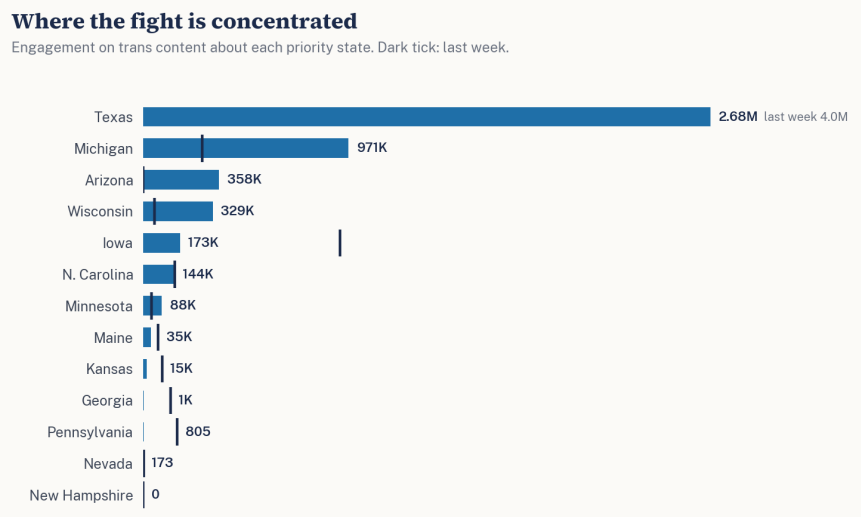
Source: Trans Rhetoric Dashboard. Off-topic viral posts removed.
Texas fell 33% and kept first place. Michigan tripled into second. Arizona and Wisconsin recorded their largest weeks in this series, each on one or two posts. Pennsylvania, Georgia, Kansas and Iowa each fell more than 80% as the prior week’s stories stopped traveling, and New Hampshire recorded zero for the first time.

Source: Trans Rhetoric Dashboard. Off-topic viral posts removed. Every priority state is labeled; other states are labeled above 100k.
Concentration increased. Texas and Michigan together are 76% of the week’s priority-state reach, and eight states cleared 30K against ten last week. This chart shows where attention went, not where the attacks are most severe. Pennsylvania, Nevada and New Hampshire are the quietest columns, and all three carry live outside advertising whose subject the public libraries do not show.
Narratives by Race
The table below covers every race on the watch list, every week, including races where no relevant advertising is running. Advertising figures come from the Meta ad library, read Monday morning, and from Google’s library, pulled in full for the seven days of this window; the ranges are the libraries’ own. Neither covers television or streaming, quoted language is written ad copy rather than a video transcript, and Google records who is spending where and never what is said. District rows count posts that name the candidates; state rows count all posts about the state.
RACE | STATUS | THE STORY THIS WEEK | REACH | WHERE IT’S RUNNING |
Texas Senate | ■ PAID | Three attack lines at once — a super PAC spot built on the Democratic nominee’s own recorded statements, a campaign video naming a drag performer he had praised, and continued circulation of the undercover recording of his minister | 2.68M | Texas PAC, the Senate Leadership Fund–linked super PAC, on Meta from Sept 21 in English and Spanish: “voted no on banning sex-change surgeries for kids”; top two statics $9K–$10K and $8K–$9K, each near 1M impressions. America PAC’s 4 Texas trans creatives total $42K–$58K. PolitiFact rated an earlier Texas PAC ad (Sept 11) False on Sept 24 |
Michigan Senate | ■ ORGANIC | A 500K clip of the Democratic nominee answering a transgender voter’s question, plus a Grand Rapids criminal case with no campaign connection that carried roughly 340K more | 971K | No trans creative from any advertiser on Meta, a second week; America PAC’s Michigan copy is socialism and policing. Google: a Trump-aligned super PAC added $254.9K in-state, subject not shown |
Ohio 9th District | ■ UNCONFIRMED | A Democratic incumbent’s own ad on “transgender ideology” in schools, and her county party’s public demand that she withdraw it | 679K | An ad-tracking service records her 15-second spot on digital platforms; it is in neither library, and neither is any trans creative from her opponent |
Arizona statewide ballot | ■ ORGANIC | One undated video of a school-board member being challenged over restroom policy carried 358K — 99.99% of the state’s week | 358K | “Proposition 318” returns no ads on Meta or Google, a fourth consecutive week. The faux-local-news page is at zero for a second week |
Wisconsin Governor + 3rd District | ■ ORGANIC | An advocacy group on the Democratic nominee for governor (150K), a New Richmond athlete’s letter to Sen. Durbin (137K), the 3rd District incumbent on his opponent (29K) | 329K | No trans creative in the state in either library. The advocacy group behind the largest post is not a paid advertiser here |
Iowa Senate + 2nd District | ■ PAID | One junior high school’s club is 73% of the state; on the campaign side, committee posts grouping the 2nd District nominee with two other Democrats | 173K | America PAC runs 6 trans creatives against the Senate nominee, $21K–$28K. No attack creative against the 2nd District nominee on Meta, and none of her own answers the issue |
North Carolina Senate | ■ UNCONFIRMED | Two athletes in four years — a former Democratic nominee’s post setting the state athletic association’s actual petition count against the Republican nominee’s hurricane-recovery record | 144K | Not re-read on Meta this week. Google: a Trump-aligned super PAC added $284.2K on 16 creatives, the Senate Republican-aligned super PAC $330.2K; subjects not shown |
Ohio Senate | ■ PAID | The most advertised transgender race on Meta — three advertisers on four pages, one advertiser new | 119K | America PAC: 6 trans creatives, $88K–$106K, top ad $40K–$45K. SLF PAC runs two pages with “permanent sex change surgeries” copy, one of them a news-styled page new on Sept 22 (top ad $10K–$15K). Sentinel Action Fund is new, Sept 23, $1K–$1.5K |
Minnesota (statewide) | ■ ORGANIC | A college athlete’s published essay about her high-school team’s loss at the Minnesota state softball tournament, circulated with the line “a vote for Peggy Flanagan is a vote for more of this” | 88K | No trans creative in the state in either library; the state senate race on the client tracker returns no ads |
Iowa 3rd District | ■ PAID | The national House Republican committee grouping the nominee with two other Democrats on girls’ sports; Punchbowl News reported that she had answered the incumbent’s ad directly | 58K | The incumbent’s war-room page still runs both sports creatives, now $900–$999 each, up from $500–$599. The Democratic nominee has 28 active creatives and none answers on the issue |
Missouri 2nd District | ■ PAID | The Republican incumbent’s own campaign put transgender attack creatives on Meta on Sept 25, after St. Louis television covered her ad on Sept 21; the Democratic challenger gave his first interview about it on Sept 27 | 3.4K | The first candidate-paid trans creative these briefings have found on Meta outside Iowa’s 3rd. Four creatives from the incumbent’s own committee: “Tax-funded transgender surgeries for minors? Fred Wellman’s agenda is simply too radical for Missouri families.” About $600–$1,000 in total |
Florida Governor | ■ UNCONFIRMED | A presidential campaign account and the Republican nominee’s war room both attacked the Democratic nominee on transgender | 55K | Not re-read on Meta this week. Google: the Republican nominee added $994.8K on 18 creatives; subject not shown |
Maine (statewide) | ■ ORGANIC | issues A clip of the 2nd District Democratic nominee on writing gender-affirming care into the Constitution; a weekend signature drive for a 2027 referendum | 35K | No trans creative in the state in either library. Three advertisers are new to the state on Google, none documented on this issue |
Kansas Senate + Governor | ■ ORGANIC | A Kansas City organizing essay that defends transgender tenants is the largest item, which is why the state reads supportive at this volume | 15K | No attack creative of any kind against the Democratic nominee for governor on Meta — a fourth week. New on Google: People Over Politics Action Fund, a super PAC running ads against Sen. Marshall, at $44K on 44 creatives; subjects not shown |
Georgia Senate | ■ UNCONFIRMED | Quiet organically — last week’s recirculated 2025 sports law stopped traveling and nothing replaced it | 1.3K | “Ossoff transgender” returns no ads on Meta, a fourth week. On Google, One Nation added $780.5K on 7 creatives; subject not shown |
Arizona 6th District | ■ ORGANIC | Three posts on the Democratic nominee deleting old social-media posts, one naming “support for Transgender issues” among the reasons | 1.1K | About 90 active creatives across both candidates — none trans, and no ad text references the nominee’s family |
New Mexico 2nd District | ■ TV ONLY | “Medicamentos De Castración” — the Spanish-language castration-drugs attack on Rep. Gabe Vasquez, an American Action Network spot | 1.1K | TV only, sixth week. “Chemical castration” returns no ads on Meta from any advertiser. The AdImpact listing, re-verified Sept 28, records a start date of Aug 20, not that the spot still airs |
Pennsylvania (statewide) | ■ ORGANIC | Nothing carried. Local coverage of the UPMC settlement continued at 2.9K without registering as state-tagged | 805 | No trans creative in the state in either library. Google: the House Republican super PAC is the largest new advertiser at $208.2K on 20 creatives |
Nebraska 2nd · New York 17th | ■ UNCONFIRMED | Quiet — no transgender-issue post naming any of the four candidates above 200 engagements | 200 | Both client-tracker items — a House Republican super PAC attack in Nebraska and a “chemical castration” item in New York — are not on Meta; that phrase returns no ads from any advertiser. Presumably television |
Nevada (statewide) | ■ QUIET | No transgender-issue narrative in the state; last week’s candidate-owned girls’-sports spot did not recirculate | 173 | Two advertisers new to Nevada on Google — a Republican House campaign pairing and a Democratic attorneys-general project. Subjects not shown |
Arizona 1st · Michigan 7th and 10th · Mississippi Senate | ■ QUIET | No transgender-issue narrative from any side in any of these four races, unchanged from last week | 10 | No trans creative in any of the four on Meta. New in Arizona’s 1st: a super PAC attack on a sex-offender registration vote — a child-safety frame, not a transgender one. Mississippi’s opaque shadow page went dark Sept 23 |
New Hampshire (statewide) | ■ QUIET | Zero engagements — the first zero column in this series | 0 | No trans creative in the state. Google: $691.8K added in-state, including $62.2K on 7 creatives from a Trump-aligned super PAC; subjects not shown |
Pennsylvania 7th and 8th Districts | ■ QUIET | No transgender-issue narrative from any side in either race, unchanged from last week | 0 | No trans creative in either race. The live attacks are taxes in the 7th and taxes and insider trading in the 8th |
Status. Paid: transgender-issue advertising found in the Meta or Google library this week. TV only: a transgender-issue television spot confirmed by press reports or AdImpact but not in the online libraries. Unconfirmed: paid activity reported but not verifiable in the libraries. Organic: the narrative circulated with no paid transgender-issue creative found. Quiet: no transgender-issue narrative in the race this week.
Three patterns run across the table. Five rows read “Paid,” against two last week; Ohio’s Senate race and Missouri’s Second District are new to the table. Ohio and Texas take more than three-quarters of the transgender spending visible on Meta. And of the eight House races on the standing roster, only Iowa’s Third carries a paid transgender creative in the online libraries; New Mexico’s Second has a television spot, and Arizona’s First and Sixth, Michigan’s Seventh and Tenth and Pennsylvania’s Seventh and Eighth are clear. A quiet district is a recorded result, not a gap in the data.
Key Findings
The frame reached the United Nations General Assembly, and the week’s largest political post on the subject was a former congressman’s one line. On Sept 22 the President told the General Assembly that the United Nations’ “top human rights officials spend their time criticizing the United States for protecting our children from transgender mutilation and transgender insanity, and enforcing our immigration laws.” One conservative account’s clip of the passage carried 2.64M; at least four further uploads followed. The same day, former Rep. Matt Gaetz posted “Bro we need your vote. I hate the war too. But the Democrats want to trans your kids,” which carried 7.4M. No campaign produced anything of that size in any state. Campaigns should plan for weeks in which statements by national figures, not advertisements, are the largest items, and should read their own state numbers separately from national volume.
A Democratic governor declined the premise on national television. Asked on CNN on Sept 27 about his 2022 veto of a bill barring transgender students from girls’ teams, Gov. Andy Beshear of Kentucky said “sports need to be fair and there should be no unfair advantage,” that Kentucky’s athletic association already had rules in place, that the state had one transgender athlete at the time — “a seventh grader that started a field hockey team in her middle school to make friends” — and that Democrats do “not throw anybody under the bus.” The exchange produced 263K across 45 posts. Republican accounts, including the national party’s research operation, carried most of that volume and treated the answer as the attack. Earlier editions of this briefing recorded seven battleground Democrats agreeing with the sports premise; Beshear declined it, and in both cases Republican accounts carried most of the volume.
A Democratic incumbent’s concession drew a public objection from her own county party. Rep. Marcy Kaptur of Ohio’s Ninth District ran a spot saying “I voted with Republicans to keep transgender ideology out of our schools.” On Sept 22 the Lucas County Democratic Party publicly asked her to withdraw it, and the county’s Stonewall Democrats sent a separate letter. The race carried 679K across 83 posts, more than every priority state except Texas and Michigan, and the national Republican committees used the advertisement to attack her record. A campaign weighing a concession should price in a second, internal news cycle alongside the external one.
Michigan tripled into second place on two items, neither of them campaign advertising. Michigan recorded 971K and reads 97% hostile. A clip of Democratic Senate nominee Dr. Abdul El-Sayed answering a transgender voter’s question about hormone care with “rights are rights are rights are rights” carried 500K on one conservative account and 50K more in a national write-up. Separately, a criminal case at a Grand Rapids children’s hospital — a former neonatal nurse charged in early September with four counts of child abuse, whose gender identity led the posts that carried it — carried roughly 340K across accounts. The case has no connection to any campaign, and treating it as a campaign event would mistake what the data shows.
Arizona and Wisconsin recorded their largest weeks in this series, and both figures rest on one or two posts. Arizona’s 358K is 99.99% a single undated video of a Peoria Unified School District board member being challenged over restroom policy; the district has been the site of a public dispute on that subject since 2023 and the exchange could not be tied to this window. Two readings fit and the record does not choose between them: a new exchange, or the recycled-content pattern recorded in Georgia last week. Wisconsin’s 329K is 87% two posts — a national advocacy group on the Democratic gubernatorial nominee (150K) and a New Richmond athlete’s open letter to Sen. Dick Durbin answering his description of the Sept 23 Senate hearing as a “vendetta” (137K). A state total at this concentration measures one or two accounts, not a state.
Three advertisers appear in the Meta library with transgender copy for the first time, and one of them is a candidate’s own campaign. Six advertisers in the races this briefing follows had transgender copy running on Meta at the Sept 28 read. The three new to the library are Texas PAC, the super PAC linked to the Senate Leadership Fund, which opened an English-and-Spanish buy against the Texas Senate nominee on Sept 21 (“He voted no on banning sex-change surgeries for kids”; two statics near a million impressions each); Sentinel Action Fund, which entered the Ohio Senate race on Sept 23; and Rep. Ann Wagner’s own campaign committee in Missouri’s Second District, which put “tax-funded transgender surgeries for minors” copy on Meta on Sept 25 at about $600 to $1,000 in total. The Missouri buy is small, and it is the first candidate-paid transgender creative these briefings have found in the Meta library outside Iowa’s Third District; every other one recorded here came from an outside group. The Senate Republican committee’s Alaska advertisement, recorded last week, ended Sept 22. A campaign should not read its own race’s absence from this list as settled.
The second paid wave has tripled in total, and more than half of it is in one state. America PAC’s twenty transgender creatives, all started Sept 20, are all still active and now total $154,000–$196,000 and at least 1.95 million impressions, against $52,000–$61,000 at the Sept 21 read. Ohio carries $88,000–$106,000 of it, Texas $42,000–$58,000, Iowa $21,000–$28,000 and Alaska under $3,300. The single largest transgender advertisement on Meta is the Ohio spot “It starts with Drag Queen Story Hour. It ends with kids going under the knife,” at $40,000–$45,000.
Four states fell more than 80%, and the fall is a story ending rather than an attack stopping. Iowa fell 81%, Kansas 83%, Pennsylvania 99.5% and Georgia 99%. In each case the item that produced last week’s figure — a town-hall answer, a rally line, a personal retrospective, a recirculated 2025 statute — simply stopped traveling, and nothing replaced it. Weekly reach measures what circulated in seven days. A campaign should not read a fall in its state’s column as a change in the advertising against it. In the same week, Google’s library records $2.92M in new in-state spending in Iowa, $2.62M in Georgia, $1.77M in Pennsylvania and $476,400 in Kansas, with no indication of subject.
The Battleground at a Glance
A post counts toward a state if it is about that state or originates there; a national account attacking Roy Cooper counts toward North Carolina. Reach figures therefore measure attention on a state, not activity within it.
STATE | PRIMARY | POSTS | REACH | VS LAST | ANTI / PRO | TOP MESSENGER |
Texas | 3/3/26 | 194 | 2.7M | ▼ 33% | 864K / 147K | Aaron Rupar |
Michigan | 8/4/26 | 43 | 971K | ▲ 249% | 941K / 20K | Charles R Downs |
Arizona | 7/21/26 | 4 | 358K | ▲ 909x | 358K / 0 | Irene BritUSA |
Wisconsin | 8/11/26 | 18 | 329K | ▲ 517% | 329K / 99 | American Principles |
Iowa | 6/2/26 | 21 | 173K | ▼ 81% | 158K / 13K | Libs of TikTok |
North Carolina | 3/3/26 | 8 | 144K | ≈ | 19K / 125K | Moe Davis |
Minnesota | 8/11/26 | 16 | 88K | ▲ 126% | 87K / 276 | Riley Gaines |
Maine | 6/9/26 | 11 | 35K | ▼ 50% | 25K / 19 | Defiant L’s |
Kansas | 8/4/26 | 11 | 15K | ▼ 83% | 5K / 9K | Cinemarxism |
Georgia | 5/19/26 | 9 | 1K | ▼ 99% | 0 / 725 | Josué Lozada |
Pennsylvania | 5/19/26 | 5 | 805 | ▼ 99% | 22 / 715 | James D Magee |
Nevada | 6/9/26 | 1 | 173 | ▼ 91% | 0 / 0 | Cargaran |
N. Hampshire | 9/8/26 | 0 | 0 | ▼ 100% | 0 / 0 | — |
“vs last” compares reach with the previous weekly edition (≈ means within ±10%). Both weeks were collected and filtered the same way, so the thirteen comparisons are direct.
One judgment shapes seven of these thirteen figures and should be read with them. Posts that name a state’s candidates, officials or institutions but never name the state are counted toward it, on the same rule applied in every edition since Aug 24. This week that rule supplied 1.91M of Texas’s 2.68M, 832K of Michigan’s 971K, 358K of Arizona’s 358K, 316K of Wisconsin’s 329K, 124K of North Carolina’s 144K, 85K of Minnesota’s 88K and 22K of Maine’s 35K. Counted the strictest way — only posts that name the state — Texas still ranks first at 769K, Michigan second at 139K, and Arizona reads 16. Both figures are correct measurements of different things: the larger one counts attention on a race, the smaller one counts attention that named the place.
Texas held first place while falling 33%; Michigan tripled into second. Two states carry a further concentration caveat. Arizona’s 358K is 99.99% one post, and Wisconsin’s 329K is 87% two posts; at that concentration the figure describes one or two accounts rather than a state. New Hampshire recorded zero for the first time in this series.

Source: Trans Rhetoric Dashboard. Tone is an automated reading; "neutral" includes hostile-leaning news coverage.
Tone is an automated, directional reading; “neutral” absorbs a large share of hostile-leaning coverage, so the anti-trans shares shown are conservative. Five states need context this week. Michigan, Arizona, Wisconsin and Minnesota all read at or near 100% hostile, which is accurate for what was posted and says nothing about opinion in those states; in Michigan and Arizona the largest items originated outside the campaigns. North Carolina and Kansas read as majority-supportive because their largest single items defend transgender people, not because either state’s politics moved. Georgia, Pennsylvania and Nevada are below 1.5K and their percentages describe a handful of posts.
How the Attacks Travel — Originators vs. Amplifiers
Reach on this subject is produced by two kinds of accounts. A small set originate stories, surfacing an incident that then spreads; a larger set amplify, delivering the most views to stories others started. Originators can be pre-empted; amplifiers require rapid response.
Top originators (seed stories that travel): Fox News (7.4M, 9 seed stories); evan loves worf (7.1M, 2 seed stories); The Dissenter (5.6M, 1 seed story); Eric Daugherty (3.1M, 10 seed stories); Aaron Rupar (1.6M, 4 seed stories).
Top amplifiers (most reach on others’ stories): Fox News (4.9M, 12 reposts); Mayor Zohran Kwame Mamdani (316K, 2 reposts); syryn (168K, 1 repost); American Principles Project (150K, 2 reposts); Daily Wire (121K, 2 reposts).
Case Studies
Case Study 1: Ohio’s Ninth District — A Concession Draws an Internal Objection
What happened. Rep. Marcy Kaptur, the Democratic incumbent in Ohio’s Ninth District, released an advertisement in which she says: “I voted with Republicans to keep transgender ideology out of our schools, because parents know what’s best for their kids,” and that “boys should not play in girls sports.” An ad-tracking service records the spot as a fifteen-second placement on digital platforms.
On Sept 22 the Lucas County Democratic Party — the party organization in her largest county — publicly called on her to take it down, saying it was “the type of harmful ad we expect from” her Republican opponent. The county’s Stonewall Democrats sent a separate letter. Toledo’s newspaper and two television stations covered the objection.
The race produced 679K across 83 posts, more than every priority state except Texas and Michigan. The largest item, at 404K, is a political aggregator’s relay of an ad-tracking service’s listing of the spot; the second, at 140K, is a progressive creator’s video headed “Democrats: stop capitulating.” The national House Republican committee grouped Kaptur with two Iowa Democrats at 22K.
Why it matters. Seven battleground Democrats have agreed with the sports premise in earlier editions of this briefing. This is the first time the objection came from inside the candidate’s own party organization and was covered as news. The record supports a narrow statement: one concession and one internal objection, in a race that drew 679K in the same week. Whether internal objection becomes a regular second cost of concession is not established by one case and will be visible in how the next concession is received.
Takeaway. A campaign considering a statement on this issue should identify, before publication, which allied organizations will be asked to respond and what they will say. The external attack and the internal objection are separate news cycles with separate audiences, and only one of them can be anticipated by the campaign that causes it.
Case Study 2: Kentucky — A Refusal on National Television, and What Followed It
What happened. On Sept 27, on CNN’s Sunday program, Gov. Andy Beshear of Kentucky was pressed about his 2022 veto of Senate Bill 83, which barred transgender students from girls’ teams from sixth grade through college and which the legislature enacted over his veto. He answered that “sports need to be fair and there should be no unfair advantage,” that Kentucky’s high school athletic association already had rules covering the question, that the state had one transgender athlete at the time — “a seventh grader that started a field hockey team in her middle school to make friends” — and that his party does “not throw anybody under the bus.” Part of the answer described the bill as having “banned all trans care for youth”; that was a different law, the 2023 Senate Bill 150, which he also vetoed. The sports bill did not address health care.
The exchange produced 263K across 45 posts. The largest were the Republican National Committee’s research account (57K, and 19K on a second post), a conservative commentator (36K), a political aggregator’s relay of the CNN clip (32K) and a conservative meme account (25K). No Democratic account above 25K circulated it.
Why it matters. Earlier editions of this briefing have recorded seven battleground Democrats moving toward the premise; Beshear declined it and was covered nationally for doing so. The distribution result is the part campaigns can use: as with the concessions recorded earlier, Republican accounts carried most of the volume. Two readings fit the data and the record does not distinguish them — that the form of the response does not change the volume of attack, or that a single case in a state without a federal race on the ballot is not comparable to a battleground concession. The October record for battleground Democrats who decline will distinguish them.
Takeaway. A campaign deciding how to answer should weigh the two options on persuasion grounds rather than on the expectation that either will reduce the attack. In every race this series has tracked, the attacks continued after the response, whichever form the response took.
Case Study 3: The Paid Frame Widens — Six Advertisers, Three New to the Library
What happened. Six advertisers in the races this briefing follows had transgender copy running on Meta at the Sept 28 read. America PAC’s second wave, launched Sept 20, is still live: all twenty creatives remain active and the set now totals $154,000–$196,000, roughly three times the Sept 21 reading, with more than half of it in Ohio.
Three appear in the library for the first time. Texas PAC, the super PAC linked to the Senate Leadership Fund that has spent $62.4M supporting the Republican nominee, opened an English-and-Spanish Meta buy on Sept 21 against the Democratic Senate nominee: “He voted no on banning sex-change surgeries for kids… Protect your kids.” The nominee did vote against Texas’s 2023 law barring transition care for minors, and has since said he opposes surgery for minors; PolitiFact rated an earlier Texas PAC advertisement, which said he “supported using taxpayer dollars for sex change surgeries on young children,” False on Sept 24. Its two static advertisements are at $9,000–$10,000 and $8,000–$9,000, each near a million impressions. Sentinel Action Fund entered the Ohio Senate race on Sept 23 at $1,000–$1,500. And Rep. Ann Wagner’s own campaign committee in Missouri’s Second District put “tax-funded transgender surgeries for minors” copy on Meta on Sept 25, four creatives totaling about $600 to $1,000; St. Louis television had covered her advertisement on the subject on Sept 21. Separately, the Senate Leadership Fund’s PAC ended its first Ohio advertisement on Sept 24 at $8,000–$9,000, replaced it with a new set, and opened a second Ohio page on Sept 22 built in a news-headline format — “Sounding the Alarm: A new revelation exposes Sherrod Brown’s extreme record…” — whose lead advertisement reached $10,000–$15,000 in six days. The National Republican Senatorial Committee’s Alaska advertisement ended Sept 22 at $4,000–$4,500.
Why it matters. The money is concentrated — Ohio and Texas take more than three-quarters of the transgender spending visible on Meta — and the Missouri buy is a different kind of thing from the rest, coming from a sitting member’s own committee rather than an outside group. Whether candidate committees take the frame on directly at scale, or whether Missouri is one member’s decision in a race one public poll puts within a point, is not established by one case; the October libraries will distinguish them.
Takeaway. The practical preparation is short and does not depend on which reading is right: the vote or statement each frame will cite, a one-sentence answer on public money, and a named person responsible for searching both ad libraries weekly under the campaign’s own candidate name. Searching by likely advertiser will miss the news-styled pages, which are named for neither the committee nor the candidate paying for them.
Attack Formats to Watch
The news-styled shadow page. A Meta page built to look like a local news outlet, carrying attack copy from its first day. The Ohio example opened Sept 22 with “Sounding the Alarm: A new revelation exposes” the Democratic Senate nominee’s record, and its lead advertisement reached $10,000–$15,000 in six days. It is paid for by SLF PAC, which runs a second page against the same candidate. Campaigns should search both libraries by their own candidate’s name, which is the only reliable way these pages surface.
The candidate’s own transgender attack. Rep. Ann Wagner’s campaign committee put “tax-funded transgender surgeries for minors” creatives against her Democratic challenger on Meta on Sept 25. It is small — about $600 to $1,000 — and it is the first candidate-paid transgender creative these briefings have found on Meta outside Iowa’s Third District; every other one recorded here came from an outside group.
The principal-level statement. Two of this week’s largest political items on the subject were statements, not advertisements: a clause in a presidential address to the United Nations (2.64M on one clip) and a former congressman’s one-line post (7.4M). Principal-level statements arrive on no campaign’s schedule, are not indexed by any ad library, and set the vocabulary that paid creative uses afterward. Campaigns should track them as a separate stream from advertising.
The school district no campaign is watching. A national account posted that a Cedar Falls junior high school was promoting a gender and sexuality club to seventh-graders; that post is 73% of Iowa’s week at 126K. The same format produced the largest single item in North Carolina and Minnesota in earlier editions. The subject is a district rather than a candidate, and the district is rarely aware of the post before the volume arrives. State parties should know which districts in their states have adopted contested policies before an account with a national following names one.
Crime coverage with the gender identity in the headline. A criminal case at a Grand Rapids children’s hospital carried roughly 340K in Michigan. The national accounts that carried it led with the defendant’s gender identity. The format has no campaign origin and no advertising behind it. This briefing records it as volume rather than as campaign activity.
The undated post presented as current. Arizona’s 358K is one video of a school-board exchange with no date attached, about a district whose restroom dispute dates to 2023; Georgia’s entire column last week was a summary of a law signed in April 2025. The format costs nothing and lands hardest where nothing current is happening.
The ballot measure that is not advertising. Arizona, Colorado, Nebraska and Washington vote Nov 3 on school-sports eligibility by sex at birth; Arizona’s measure also covers bathrooms and locker rooms. “Proposition 318” returns no advertisements in the Meta or Google libraries for a fourth consecutive week. The Yes committee, chaired by attorney Tim La Sota, released one advertisement in August, posted to its website and YouTube and built on a 2024 Massachusetts basketball clip; the No side is run by a progressive advocacy group’s program. Any current advertising for the measure is running where the public libraries do not index it — television, streaming, radio or mail — or has not started.
Looking Ahead — The Calendar
September 29 and 30: two North Carolina dates in the same week. On Sept 29 the state Court of Appeals hears a bid to revive a detransition malpractice suit dismissed on timing grounds, after a 2025 state law extended the filing window for exactly these claims. On Sept 30 the fifteen-day clock on the Thomas More Society’s demand letter to Wake County Public Schools runs out: a refusal produces a lawsuit, an accommodation produces a template other districts will be asked to match. North Carolina carried 144K this week, and neither Senate campaign has engaged the subject.
October 13: the Medicaid rule takes effect. Federal Medicaid and CHIP funding for transition-related care for minors ends, with a taper for patients already in treatment, and the 22-state lawsuit filed Sept 4 is trying to stop it. States may continue covering the care with their own funds — “may, not must” — which turns one federal rule into thirteen separate state questions three weeks before Election Day.
End of October: the Texas detransition clinic is due to open. Under the settlement the state attorney general secured in May, Texas Children’s Hospital must open the country’s first “detransition clinic” by the end of October, fund it for five years and pay the state $10 million. An opening three days before the election is a scheduled media event and is already on the calendar.
Through October: federal hospital settlements arrive on a rolling basis. Six systems have now settled, most recently a Pennsylvania system for $950,000 and a New York system for $8.5 million, both announced Sept 18. The New York settlement produced a second event this week: activists injected hormone therapy outside that hospital on camera in protest, which carried 2.74M and 1.62M on two accounts. Each settlement lands as a local story on no announced schedule, and each is capable of producing a national one.
The last week of October: the stated target. The President said on Sept 9 that he normally likes to raise this subject “about a week before the election” and called it “one of our great sound bites of all time.” His Sept 22 address to the United Nations put the subject in a major address five weeks before that target. Campaigns should plan for principal-level attacks at scale in the final ten days and should not read the current pace as the ceiling.
November 3: four states vote on this directly, for the first time in American history. Arizona, Colorado, Nebraska and Washington will decide whether school-sports eligibility must follow sex at birth; Arizona’s measure also reaches bathrooms and locker rooms, and Colorado and Missouri carry separate questions on medical care for minors. Arizona is the priority state on that list, no advertiser naming its measure appears in Google’s library for a fourth consecutive week, and the state’s 358K this week came from a school-board video rather than from the measure. It is the least visible item on this calendar.
The Bottom LineThe frame occupied its highest-profile venue of the cycle this week and drew a refusal on national television. One clip of the President’s Sept 22 line to the United Nations General Assembly carried 2.64M and a former congressman’s one-line post carried 7.4M; no campaign produced anything that size anywhere. On Sept 27 the governor of Kentucky declined the premise on national television, and, as with the concessions recorded earlier, Republican accounts carried most of the volume. Five days earlier a Democratic incumbent in Ohio was publicly asked by her own county party to withdraw an advertisement conceding it. The record now contains a concession, a refusal and an internal objection within six days; what it does not contain is a case in which any of the three reduced the attack. On the map, concentration increased. Texas and Michigan together are 76% of the week’s priority-state reach, Michigan’s rise came from a criminal case and one answer at a public event, and Arizona and Wisconsin recorded their largest weeks in this series on one and two posts respectively. Four states fell more than 80% because last week’s stories stopped traveling, not because anything stopped. On the paid side the frame widened. Six advertisers in the races this briefing follows had transgender copy running on Meta at the Sept 28 read, and three appear in the library for the first time: Texas PAC in the Texas Senate race from Sept 21, a fund that entered the Ohio Senate race on Sept 23, and a sitting House member’s own campaign committee in Missouri, the first candidate-paid transgender creative these briefings have found on Meta outside Iowa’s Third District. The Senate Republican committee’s Alaska advertisement ended Sept 22. America PAC’s second wave is still live and has tripled in total to $154,000–$196,000, at a daily pace about two-thirds of its first wave’s. What that combination means is not established: three new names in the library in one week is either the start of a broader buy or three separate decisions, and the October libraries will show which. Ohio and Texas take more than three-quarters of the transgender spending visible on Meta, and of the eight House races on the standing roster only Iowa’s Third carries a paid transgender creative in the online libraries. |
Limitations
Geography comes from two reads: which state a post is about (roughly 10% of posts carry one) and where the account behind it is based (roughly 2% of accounts). A post can be about a state without originating there, so state reach measures attention, not local activity. Off-topic viral posts are excluded. The largest single judgment in this edition is the rule that counts posts naming a state’s candidates, officials or institutions toward that state even when they never name the state. It has been applied the same way every week since Aug 24, and this week it supplies most of seven columns: counted the strictest way, Texas reads 769K rather than 2.68M, Michigan 139K rather than 971K, and Arizona 16 rather than 358K. Texas ranks first on either count.
Tone is an automatic, directional read; “neutral” absorbs much hostile-leaning news, so anti-trans shares run conservative. This covers a fixed seven-day window (Sept 21 – 27), computed on a locked copy of the data; both weeks compared here were collected and filtered the same way, so the thirteen state comparisons are direct. Paid-media figures come from two public libraries, both checked Sept 28. Meta’s publishes spending and impression bands per creative and the advertisements’ written copy, which is what the quotations here are; video frames were not reviewed, and its keyword searches return the top twenty to thirty results, so the largest result sets were sampled. Google’s publishes advertiser, state, dates and money and never the content of a creative. Neither covers television or streaming. North Carolina and the Florida governor’s race were not re-read on Meta this week and are marked Unconfirmed for that reason, and one television spot is carried on a listing that records its start date and not that it still airs.
Arizona’s 358K rests on one undated post about a district whose restroom dispute dates to 2023, and Wisconsin’s 329K is 87% two posts. This briefing contains no survey, panel or message-testing content of any kind; every recommendation derives from observed engagement data, the public ad library, and the public record cited here. Engagement is not persuasion.
Methodology
Data source. Trans Rhetoric Social Media Dashboard, built for TFA on the Junkipedia social listening API — 79,000+ channels across 20 platforms, 1,000,000+ posts spanning December 2023 to present, collected on 90+ keywords. Period: September 21 – 27, 2026, the sixth weekly edition. Priority states are drawn from Adrienne’s “TFA priority states-races 5.18.26” sheet, plus Iowa (Jun 9 request) and Texas. Per-state signal counts trans-relevant posts by which state they are about and where the account is based, with a manual audit of the highest-engagement posts.
Named people, events and quotes were checked against primary or mainstream published sources; where a claim could not be sourced it is identified as unverified in the text or omitted. Paid media comes directly from the Meta Ad Library and from Google’s Ads Transparency Center bundle, both checked Sept 28, 2026, plus one ad-tracking listing for a New Mexico television spot; spending and impression figures are the ranges the libraries publish, not estimates of ours. Private individuals who are not office-holders, candidates or public officials are not named here, even where the content attacking them does; that applies in this edition to a nurse charged in Michigan, a hospital patient, an Iowa school employee and a seventeen-year-old athlete in Wisconsin. Minor children of candidates are never named in these briefings under any circumstances. Legal characterizations of the Medicaid rule follow the published rule: federal funding ends, state-only coverage is permitted, a taper for patients already in treatment is allowed — “may, not must.”
Diffusion: Originators vs. Amplifiers
The originator/amplifier analysis separates the accounts that start a story from those that give it the most reach. Near-identical posts are grouped so the same claim or clip is tracked as it reappears across accounts, and the platforms’ own quote, reply and repost links connect each amplifying post to the item it echoes. Within a story group the originator is the earliest poster (or, for a quote chain, the account being quoted), and amplifiers are ranked by the reach they add. Caveats: the platform links exist on only about 36% of posts, heavy paraphrase escapes the grouping, and “originator” means earliest in this data set.


